You know you're supposed to change the filter. You're just not sure how often — and every time you search for an answer, you get a different one.
Here's the short version: it depends on your filter type, your home, and who lives there. A dirty filter can increase your HVAC energy consumption by up to 15%, according to the U.S. Department of Energy. On a $150/month heating and cooling bill, that's an extra $270 a year. Over time, a clogged filter also wears out your blower motor, can freeze your AC coils, and shortens the life of a system that costs $5,000–$12,000 to replace. A few dollars a year in filters is an obvious trade-off.
Filter intervals in this post reflect guidance from the U.S. Department of Energy, ENERGY STAR, and Carrier. Always check your system's owner's manual — HVAC equipment varies.
How Often to Change Your HVAC Filter
The right interval depends on what type of filter you have and what's going on in your home.
Basic fiberglass filters (thin, cheap, 1-inch): Change every 30 days. These protect your equipment from large debris but don't do much for air quality, and they clog fast. If you're using these, consider upgrading to a pleated filter.
Standard pleated 1-inch filters: Change every 60–90 days under normal conditions. This is the most common filter type. If you're not sure what you have, this is probably it.
Higher-MERV pleated filters (MERV 11–13): Check at 60 days and replace if dirty. These capture finer particles, which means they fill up faster. Worth it if anyone in your home has allergies or asthma — the difference between a $8 standard filter and a $25 MERV 11 filter is about $50 a year, and allergy sufferers will notice the improvement.
Thick 4- or 5-inch deep filters: These can last 6–12 months. The extra surface area lets them collect much more material before restricting airflow. Don't treat these on the same schedule as a 1-inch filter.
Adjust for your household:
- Pets: One dog or cat cuts filter life roughly in half. Two or more pets — change every 4–6 weeks.
- Allergies or asthma: Change every 30–45 days. During peak allergy season (spring and fall), check more frequently.
- Vacation or low-occupancy homes: Can stretch to 6 months with no pets.
- Active renovation: Check weekly, replace every 2–4 weeks. Construction dust is extremely hard on filters.
ENERGY STAR's simple rule: Check the filter once a month. If it looks dirty, replace it. If it doesn't, check again next month.
What Are MERV Ratings?
MERV stands for Minimum Efficiency Reporting Value — it tells you how well a filter captures particles. Higher number = finer filtration.
- MERV 8: Dust, dust mites, pollen, pet dander
- MERV 11: Everything above, plus finer allergens
- MERV 13: Everything above, plus smoke and bacteria
For most homes, MERV 8–11 is the sweet spot. Going above MERV 13 can restrict airflow in standard residential systems — especially older ones — which actually raises your energy bill and shortens equipment life. If you want better filtration, check your system manual before going above MERV 11 on an older unit. Modern systems (roughly 2010+) generally handle MERV 13 fine.
Signs Your Filter Needs Changing
Don't just go by the calendar — look at the filter:
- It's visibly gray or brown. A new filter is white or very light.
- More dust than usual on surfaces and vents.
- Reduced airflow from registers.
- The system runs longer or cycles on and off more frequently.
When to Call a Pro
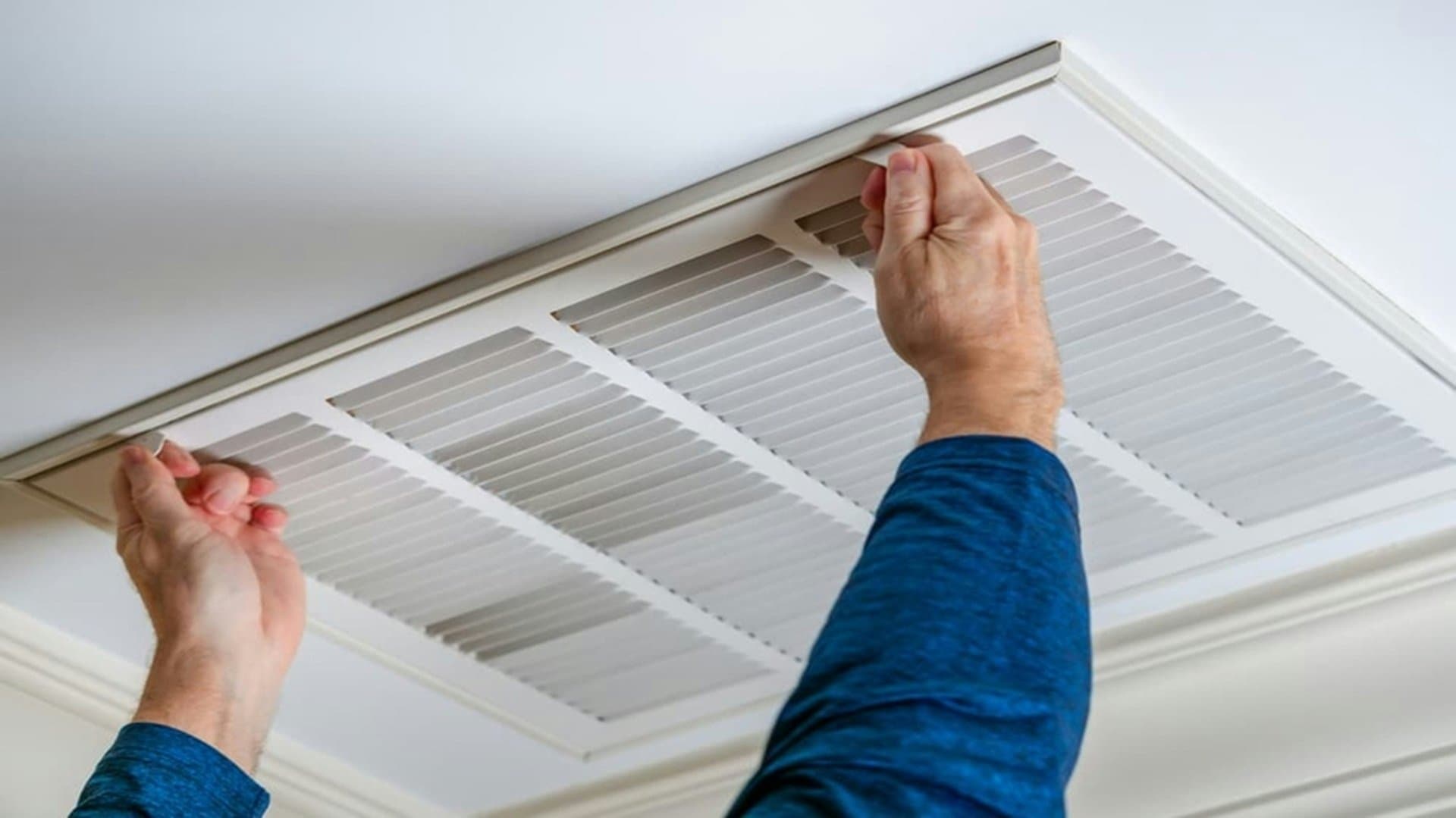
Changing a filter is something most homeowners can handle. The filter slot is usually behind a vent cover in a hallway ceiling, a wall return vent, or inside the air handler. Pull the old one out, note the size printed on the frame, and slide a new one in with the arrow pointing toward the blower.
Call a pro when:
- You can't locate your filter slot
- The system still runs inefficiently after replacing the filter
- You want to upgrade filter types and aren't sure what your system can handle
- You haven't had an annual HVAC tune-up — a technician checks the filter as part of that service
A professional tune-up costs $75–$200 and covers refrigerant, coils, airflow, and system testing. Schedule one in spring for AC and fall for your furnace.
What Filters Cost
- Basic fiberglass: $1–$5 each (12/year = $15–$60 annually)
- Standard pleated MERV 8: $8–$15 each
- MERV 11: $20–$30 each
- MERV 13: $25–$50 each
- 4- or 5-inch thick: $25–$60 each, but they last 6–12 months
Buying multi-packs from warehouse stores or filter subscription services costs less per filter.
Set a Reminder and Forget About It
The hardest part about filter changes is remembering to do them. You can't see the filter from where you live your life. There's no warning light.
The HVAC Filter Replacement template in Mintain reminds you every 2 months by default — adjust the interval if your household needs more or less frequent changes. Store your filter size in the notes field so you know exactly what to grab.
Track filter changes in Mintain for free at mintain.app →
If you're thinking about spring maintenance across the whole house, Spring Home Maintenance: 10 Tasks You Shouldn't Skip This Year covers HVAC, gutters, smoke detectors, and more in one place.
What size filter do I need? The size is printed on the frame of your current filter. Common sizes are 16x25x1, 20x20x1, and 20x25x1. Getting the wrong size means air bypasses the filter along the edges.
Can I vacuum a filter instead of replacing it? Disposable filters aren't designed to be cleaned — vacuuming can damage the filter media. If yours is labeled washable, follow the manufacturer's instructions. Otherwise, replace it.
This is part of Mintain's weekly maintenance blog. Every Monday, we publish a new guide to help you stay ahead of home, auto, yard, and equipment maintenance — so nothing catches you off guard.