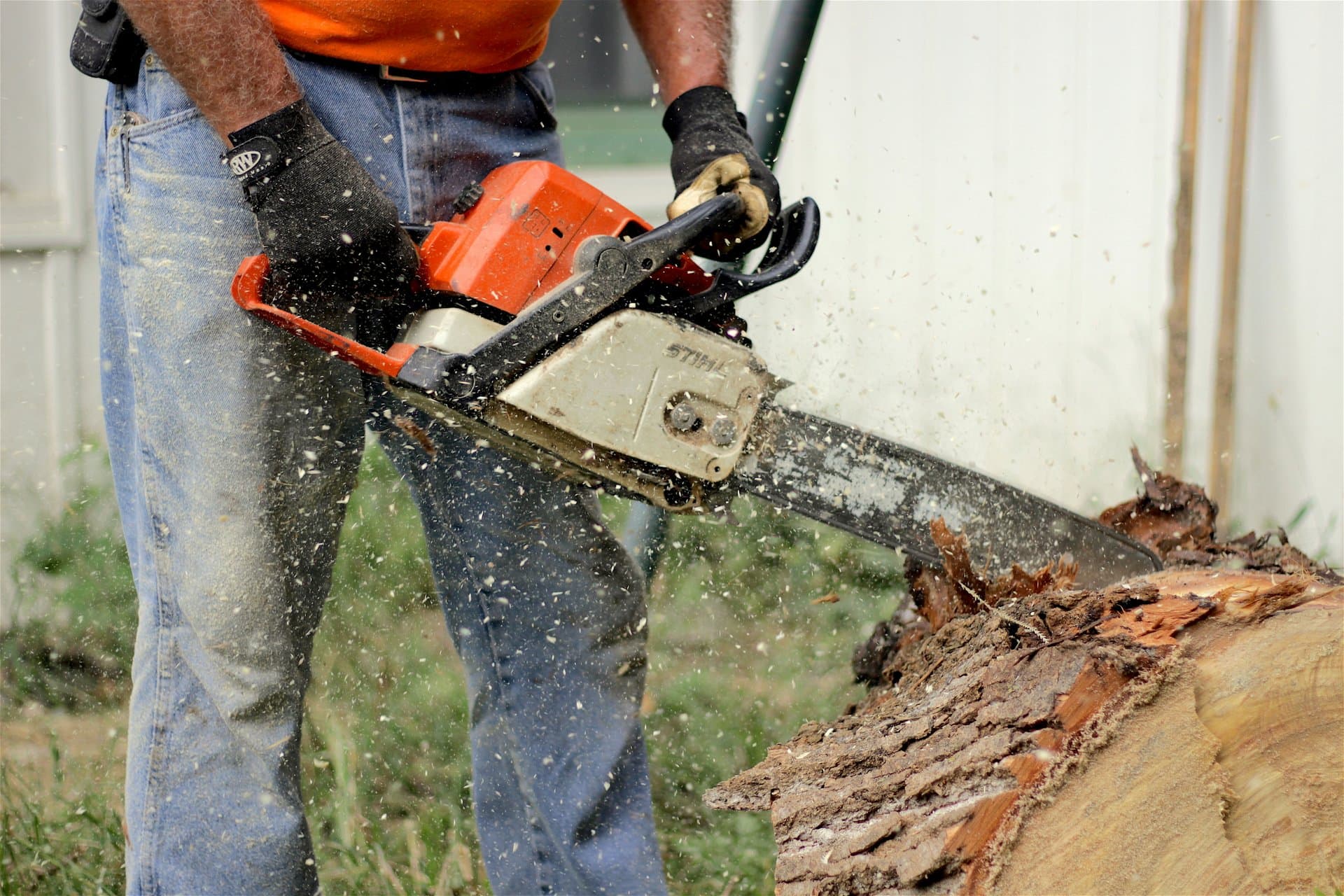
A chainsaw that's gone dull doesn't announce itself. It just starts making you work harder — leaning on the saw, cutting crooked, throwing sawdust instead of chips — and that's the point where it becomes genuinely dangerous.
Most of us pull the saw out a handful of times a year: a limb came down, a tree needs bucking up for firewood, a storm left a mess in the driveway. It sits the rest of the time. That on-and-off pattern is what makes chainsaw maintenance and chain sharpening easy to skip and expensive to ignore.
The good news is that a chainsaw asks very little — a two-minute check before you start, a sharp chain, and one real service a year. Here's what each looks like, and where the line sits between what you can handle and what belongs at a shop.
Intervals here reflect manufacturer guidance from STIHL and Oregon, plus chainsaw safety recommendations from the CDC. Check your own owner's manual — exact figures vary by model.
The Two-Minute Check Before You Start
STIHL recommends checking a saw before and after every use, and three things matter most:
- Bar oil. The reservoir that lubricates the bar and chain empties at roughly the same rate as the fuel tank, so top it off every time you fill up. Running a chain dry ruins the bar and the chain together. Use bar and chain oil — motor oil doesn't have the tackiness to stay on a moving chain.
- Chain tension. A properly tensioned chain sits snug against the bar but can still be pulled around by hand (with a glove on). Too loose and it can jump the bar; too tight and it binds and wears fast. A new chain stretches during break-in, so check it often the first few times you use it.
- The chain brake. That's the guard in front of the top handle. Push it forward and the chain should stop instantly. If it doesn't engage crisply, stop — this is the feature that protects you during kickback, and it's not optional.
Chainsaw Maintenance and Chain Sharpening: How Often
There's no calendar interval for sharpening, because it depends entirely on what you're cutting. Sharpen when the saw tells you to. The signs are consistent:
- The saw throws fine sawdust instead of chunky chips. This is the clearest tell.
- You have to push down to make it cut, instead of letting the saw pull itself into the wood.
- It cuts on an angle rather than straight through.
- It smokes or scorches the wood even with plenty of bar oil.
One touch of the chain against dirt, a rock, or a buried nail dulls it instantly, so a chain that was fine an hour ago may not be now. As a rough baseline, expect to touch it up every couple of tanks of fuel in clean wood, and sooner in dirty or frozen wood.
Sharpening means filing each cutting tooth to a consistent angle and depth — a learnable skill, but one that goes badly when it's done unevenly, since a chain with mismatched teeth cuts crooked and vibrates. Most shops sharpen a chain for about $10–$30, and for a saw you use a few times a year, that's a reasonable thing to pay for. Many owners keep two chains and rotate them, so one is always sharp.
Chains don't last forever. Every sharpening removes a little steel, and manufacturers stamp wear markers on the cutters. Once a tooth is filed down to that marker, the chain gets replaced — filing past it risks a tooth breaking off under load.
Don't Forget the Bar
The guide bar wears too, and it's the part most people never think about. Two things keep it alive:
Flip it. Every time you replace or swap the chain, turn the bar over and reinstall it. That spreads wear evenly across both rails instead of grinding down one side.
Clean the groove. Sawdust and hardened bar oil pack into the groove and plug the oil holes, which starves the chain of lubrication. Scrape the groove out with a narrow screwdriver or a groove-cleaning tool, and make sure the oil hole is clear.
If the rails have burred over or the bar won't stand upright on a flat surface, it's worn unevenly — a shop can dress the rails, or it may be time for a new bar.
The Once-a-Year Service
STIHL's general guidance is a full service every 25 hours of use or at the end of the cutting season, whichever comes first. For most homeowners, that means once a year — and the end of the season is the better time, so the saw isn't sitting all winter dirty and full of old fuel.
The annual list is short:
- Air filter. Clean it during the season and replace it annually; a new one typically runs $5–$15. A clogged filter makes the engine run rich, start hard, and stall.
- Spark plug. Replace annually or every 100 hours. Plugs run $4–$8.
- Spark arrestor screen. The small screen in the muffler clogs with carbon and chokes the saw. It gets cleaned or replaced yearly.
- Fuel filter. Replaced annually — it's the small weighted filter inside the fuel tank.
- Drive sprocket. The sprocket that pulls the chain wears grooves into itself, and STIHL puts the wear limit at about 0.5mm of visible wear. A worn sprocket chews through chains and bars faster and makes the chain harder to keep tensioned. If you're not sure what you're looking at, have the shop check it during a sharpening.
- Fuel. Most gas chainsaws run the same two-cycle mix as a string trimmer, and it goes stale the same way. Our string trimmer service guide covers fuel mixing, stabilizer, and why old mix causes most no-start headaches — the same rules apply here.
A full shop tune-up for a chainsaw generally runs $50–$100 plus parts, which usually covers the filter, plug, fuel system, a sharpened chain, and a general look-over.
If You Have a Battery Saw
Cordless saws skip the fuel, air filter, spark plug, and spark arrestor entirely — a real reduction in upkeep. But everything on the cutting end is identical: a bar oil reservoir that needs filling, a chain that dulls, a bar that needs flipping and cleaning, and a sprocket that wears. Store the battery indoors at room temperature rather than in an unheated shed over winter.
Safety, and When to Call Someone
Chainsaws send roughly 36,000 people to emergency rooms in the U.S. each year, and kickback is cited in up to a third of those visits. Injuries land most often on the left leg and the back of the left hand. Cut-resistant chaps exist for exactly that reason: they jam the chain and stop the saw within about one rotation. Chaps, eye and ear protection, gloves, and boots are the baseline any time the saw is running — and a sharp, properly tensioned chain is itself a safety feature, since a dull chain grabs and forces you to push.
Take the saw to a small-engine shop when it won't start on fresh fuel and a new plug, when it runs but bogs or smokes heavily, when the chain brake doesn't engage crisply, or when the chain won't hold tension.
And take the job to a professional when it isn't really about the saw. Call a licensed, insured arborist for anything overhead, any tree near power lines or a structure, any felling you aren't fully confident in, and any storm-damaged tree under tension. That's a different level of risk than bucking a log on the ground, and it's not one to learn on.
Track Your Chainsaw Service in Mintain
A chainsaw is easy to forget precisely because you don't use it often. It goes back in the shed after a job, and the next time you need it is six months and one emergency later — dull chain, empty bar oil, stale fuel.
Add your saw to Mintain and apply the Chainsaw Service templates: air filter, spark plug, fuel filter, spark arrestor, sprocket, and chain brake, each on its own schedule. You get the reminder before the season, not the morning a branch is across the driveway.
Free for up to 4 items, so your saw and a few other machines fit at no cost. Pro is $1/month or $10/year if you track more.
Add your chainsaw to Mintain at mintain.app →
A sharp chain does the work so you don't have to — and next week we'll get into the lint trap you can't reach, and why dryer vents start more house fires than almost anything else in the laundry room.
This is part of Mintain's weekly maintenance blog. Every Monday, we publish a new guide to help you stay ahead of home, auto, yard, and equipment maintenance — so nothing catches you off guard.