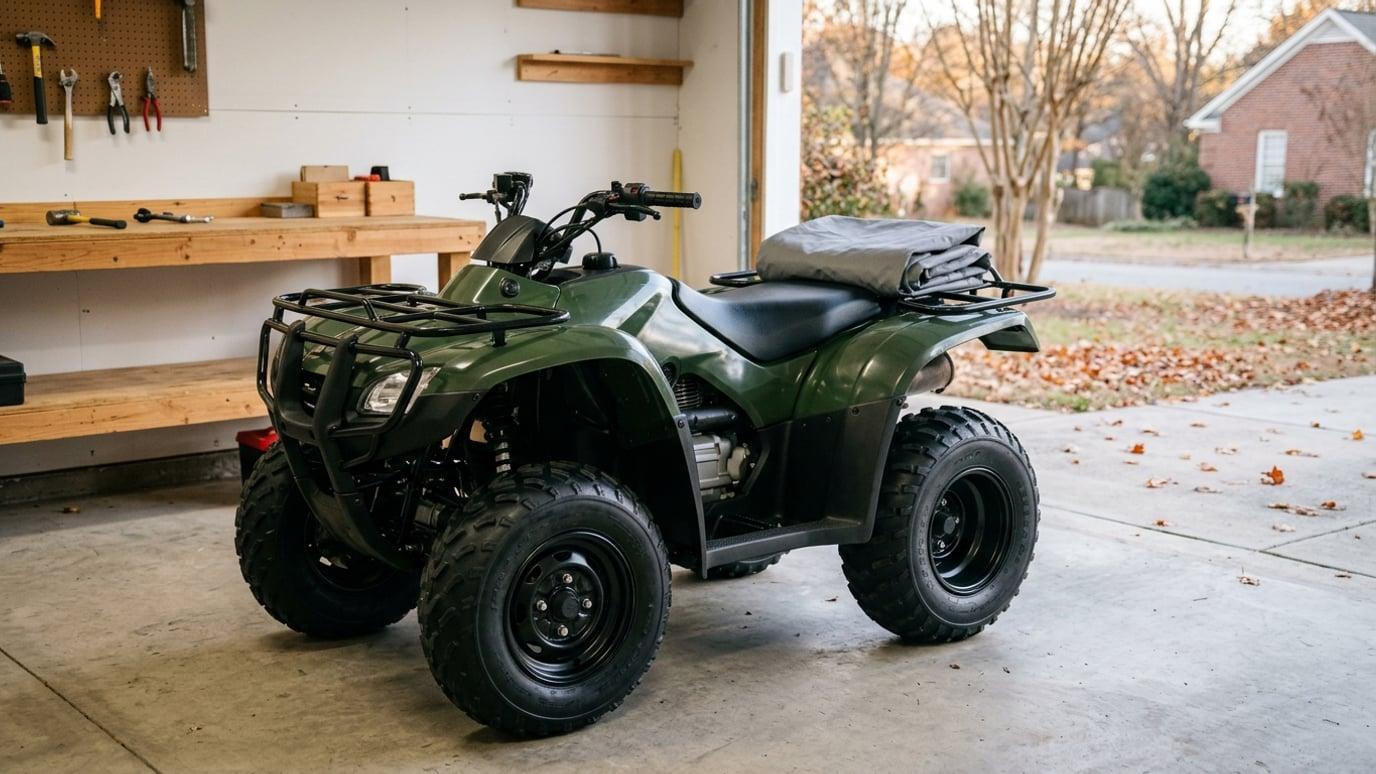
The last ride of the year usually ends with mud on the fenders, the key on a hook, and a promise to deal with it later. Then spring comes, and the battery is dead, the gas has gone stale, and something has been chewing on the wiring.
When you winterize your ATV or UTV, you're preparing it to sit still for four or five months. The maintenance before storage comes down to a short list: fuel, oil, coolant, battery, tires, and keeping mice out. You can do much of it at home or hand all of it to a dealer. Either way, it helps to know what the job includes.
If your machine plows the driveway or hauls firewood all winter, it isn't going into storage, so you can skip this for now. Everyone else, here's the order to do it in.
Guidance below reflects storage instructions from Polaris, Can-Am, Honda, and Yamaha, along with State Farm, ATV.com, and the CDC. Your owner's manual is the final word for your machine.
Start With a Good Wash
Dried mud holds moisture against metal all winter, so cleaning comes first. State Farm also says to rinse the mud out of the radiator fins, a spot many people miss.
Go gently with the pressure washer. Can-Am suggests using one on the body and undercarriage, but Polaris warns that high pressure can force water past seals, and it names wheel bearings as a spot to avoid. A garden hose or a low setting is the safer choice.
Then finish the job before the water does any harm:
- Dry it well, including the spots that hold water.
- Lube the chain, if your machine has one. Yamaha says to do this right after washing to prevent rust.
- Grease the fittings on the suspension and steering. Polaris says to do this right after washing, too.
A clean machine is also the easiest one to check. Look for drips, cracked hoses, and torn rubber boots around the axles. A torn boot lets grit and water into the joint behind it, which can ruin the joint.
Winterize Your ATV: Fuel, Oil, Coolant, and Air Filter
Fuel. Honda warns that stale fuel can turn into a residue that plugs fuel lines. Its manuals also say that if a machine sits for more than two months without stabilizer, a dealer should drain and replace the fuel.
The usual fix is to fill the tank, add stabilizer as the bottle directs, and run the engine so treated fuel reaches the whole system. Brands differ on how long. Can-Am says a few minutes, and one Polaris manual says 15 to 20. Draining the system is the alternative, and your manual will say whether it applies to your machine. If you also own a boat, this step will look familiar from our boat winterizing checklist.
Run the engine outside, every time. The CDC says never to run a gasoline engine in a garage, even with the door open, because of carbon monoxide. Roll the machine out onto the driveway first.
Oil. Honda, State Farm, and most storage guides say to change the oil and filter before storage, so used oil isn't sitting in the engine all winter. Run the engine briefly afterward to move the clean oil around. Honda adds a spring step: if the machine sat for more than four months, change the oil again before you ride.
Coolant. This applies only to liquid-cooled machines, and your manual will tell you which kind you have. Polaris says to test the coolant's strength, not only its level. Coolant that's too weak can freeze, and freezing coolant expands, which can damage the radiator. A shop can test it for you.
Air filter. Polaris says to replace it and clean out the air box before storage. State Farm says to clean the filter and the inside of its housing. Check your manual, since some filters can be cleaned and reused.
Take Care of the Battery
A battery can't sit neglected until spring. Polaris's manuals warn that a battery left unused for 60 days may be damaged and unable to recharge.
- Take it out. Can-Am and Honda both say to remove it for long storage. If yours stays in, Honda says to disconnect the negative terminal.
- Charge it fully, then keep it on a battery maintainer or tender, a small charger that tops it up on its own. If you don't have one, Honda's manuals call for a slow charge about once a month.
- Store it somewhere cool and dry that doesn't freeze, like a basement. Keep it away from children.
Tires, Mice, and Where It Sits
Tires. Set them to the pressure in your manual. When a tire holds up the machine's weight in one spot for months, it can deform. Can-Am, Honda, and State Farm all suggest stands or blocks that take the weight off, if you have them. If lifting it isn't realistic, ATV.com suggests rolling it a few inches every couple of weeks.
Mice. Can-Am warns that mice can damage wiring and other parts. State Farm and Polaris both say to cover the exhaust and air intake openings so small animals can't crawl in. Those covers have to come off before you start it again, so leave yourself a reminder. Keep birdseed and pet food out of the storage area, since they draw mice in. Owners report mixed results with repellents, so don't count on them alone.
The cover. Polaris says to use fabric, not plastic or vinyl, which trap moisture and encourage rust. Honda adds that you should let the engine and muffler cool first. If the machine lives outside, use a weatherproof cover that still breathes, and pull it off after wet weather so everything can dry.
The spot. Indoors is best. Pick somewhere dry and ventilated, out of direct sunlight, like a garage or shed. If parking it means the snow blower moves up to the front of the garage, our snow blower guide covers getting that ready.
When to Take It to a Shop
Handing the whole job to a dealer is a perfectly good plan. Definitely call one if:
- It runs rough, won't start, or is leaking anything before you put it away. Problems like these are easier to sort out now than in spring.
- You see a torn axle boot, or a UTV's drive belt looks cracked or frayed.
- Your coolant tests weak or looks dirty.
- Your manual calls for fogging. That means putting a little oil into each cylinder through the spark plug hole to prevent rust. One Polaris manual says never to start the engine during storage after fogging, because it disturbs that protective coating.
Few shops post a price for this. The two we found that list hourly labor charge about $85 to $125 an hour, plus parts and supplies, so call for a quote. Ask what's included, because packages vary. One North Carolina dealer's basic winterization covers fluid checks, battery service, fuel stabilizer, and tire pressure, and only its premium package adds an oil and filter change and detailed cleaning.
Track Your ATV Winterizing in Mintain
Winterizing happens once a year, which makes it hard to remember what you did last time. That's what Mintain is for.
Add your machine under Toys and pick from the ATV / Quad or UTV / Side-by-Side templates:
- Winterization / Storage Prep: annually, the week you park it.
- Engine Oil & Filter Change: every 6 months or 100 hours.
- Air Filter Service: every 6 months or 50 hours.
- Battery Service: annually.
- Coolant Flush: every 2 years, liquid-cooled machines only.
- CV Boot Inspection (ATV) or CVT Drive Belt Inspection (UTV).
For spring, ATV owners can add Spring De-Winterization. UTV owners can set up a custom task with the same name. Put "take the covers off the exhaust and intake" in the notes, so that's the first thing you see.
Free for up to 4 items. Pro is $1/month or $10/year if you track more.
Add your ATV or UTV to Mintain at mintain.app →
Put it away clean, charged, and covered, and the first ride of spring starts with the key instead of a repair bill. Next week: fireplace and chimney safety before you light the first fire of the season.
This is part of Mintain's weekly maintenance blog. Every Monday, we publish a new guide to help you stay ahead of home, auto, yard, and equipment maintenance — so nothing catches you off guard.