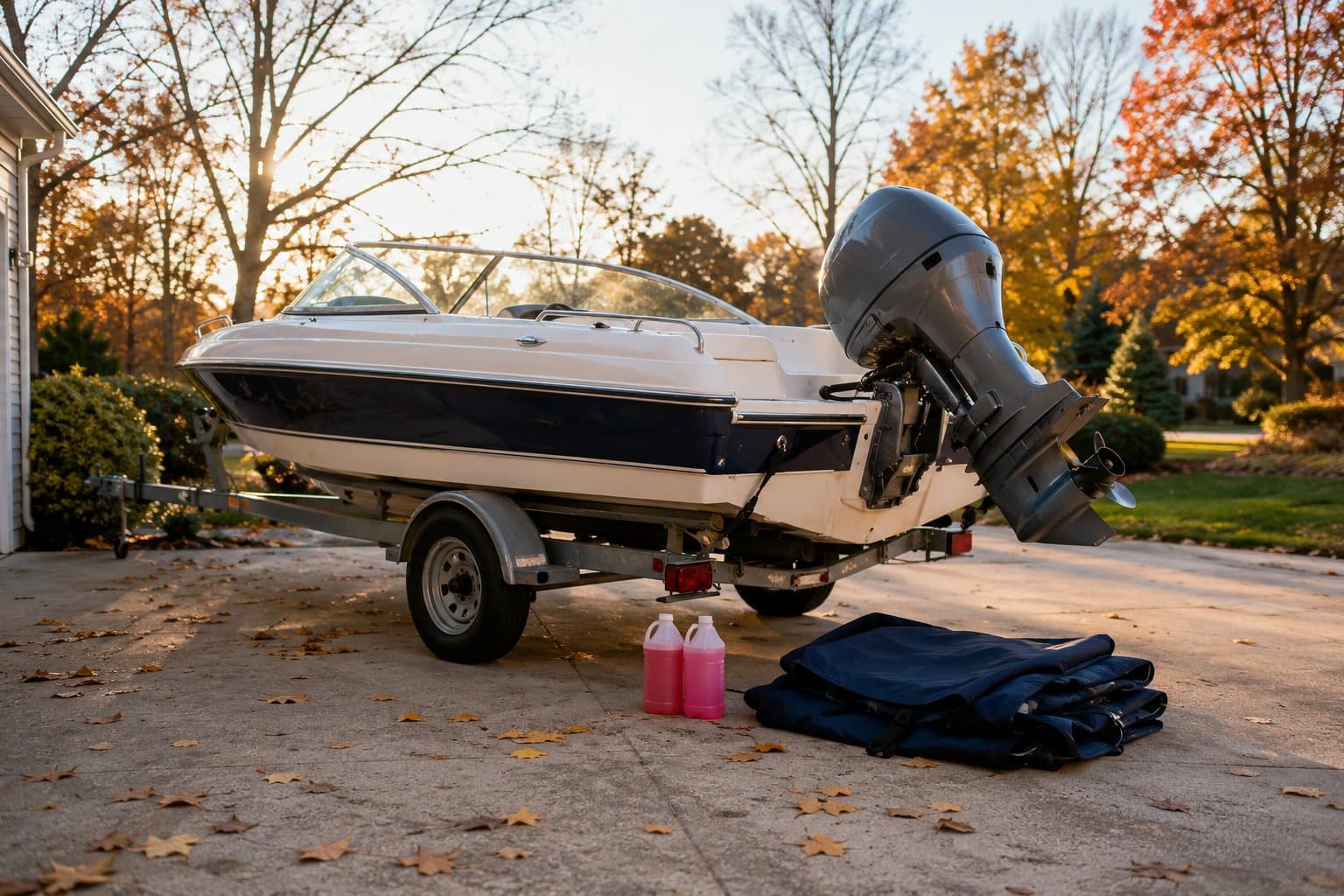
A boat doesn't have to be in the water to be ruined by it. The water that does the damage is the half-cup left sitting in an engine in November — and it finishes the job on one cold night while the boat sits under a cover in your driveway.
Fresh water expands about 9% when it freezes, hard enough to split an engine block, a gearcase, a hose, or a pump housing. None of it makes a sound. You find out in May.
A winterize boat checklist is really a short list of places water hides, plus a few things that go stale while the boat sits. Late August is early to be thinking about it, and that's the point — the appointments, the parts, and one insurance decision all get harder to arrange later.
Guidance below reflects recommendations from Discover Boating, BoatUS, Mercury Marine, and the Virginia Department of Wildlife Resources, along with current marina and insurer pricing. Your owner's manual is the final word for your engine — procedures vary by make.
The Deadline Is a Temperature, Not a Date
There's no calendar date for this. There's a forecast.
An unwinterized engine can freeze once air temperatures sit below about 28°F for an extended stretch. A freshwater-cooled engine without proper coolant can freeze below 32°F. Wind makes it worse — a breezy night pulls the boat a few degrees below what the thermometer says.
The honest deadline, then, is the first hard overnight freeze in your area — and one night of it is enough.
Marinas know this, which is why their fall calendars fill from the top. Booking in late summer gets you a date; calling after the first cold snap gets you a waitlist.
Your Winterize Boat Checklist Depends on What's Hanging Off the Back
Before anything else, know which kind of boat you have. It changes the entire job.
An outboard — the engine mounted on the transom, outside the hull — is designed to drain itself. Store it tilted all the way down, fully vertical, and gravity pulls the cooling water out through the same passages it came in. Tilt it up and back down once to shake loose what's trapped. Done correctly, an outboard needs no antifreeze in the engine at all.
A sterndrive or inboard — the engine inside the hull, with a drive unit or a shaft — traps water in the block, the manifolds, and the hoses, and it cannot drain itself. That water has to be let out through block drain plugs, and marine antifreeze has to go in behind it.
An outboard owner who tilts the engine down and treats the fuel has done most of the job. A sterndrive owner has not started yet.
Getting the Water Out
For a sterndrive or inboard, this is the step everything else is secondary to. Removing the block drain plugs lets the trapped water out and takes some sediment and scale with it. Then marine antifreeze gets circulated through the cooling system and the drive to protect whatever didn't drain.
Two things about that antifreeze matter.
Use marine or RV antifreeze — propylene glycol, the pink stuff. Never automotive antifreeze. Automotive coolant is ethylene glycol, and it is severely toxic to people, pets, and anything living in the water it eventually reaches.
The number on the jug is burst protection, not freeze protection. A -50°F product turns slushy well above that temperature — it simply doesn't expand hard enough to break anything. That's the behavior you're buying. It also only works undiluted — leftover water that thins it raises the real protection point sharply.
Fogging is the other half of engine protection — an oil mist sprayed into the air intake that coats the cylinder walls so they don't rust over the winter. Many newer outboards have a built-in winterize mode that handles it instead; your manual will say which yours has.
One shortcut to skip: a space heater in the engine compartment is not a substitute for any of this. Insurers report it causing both engine damage and boat fires, and it leans on a power supply holding for months.
Fuel: Nearly Full, and Treated
Here the advice runs opposite to what you'd do with your lawn mower at the end of the season, where draining the tank is a reasonable option.
A boat's built-in tank should go into storage nearly full — around 95% — with fuel stabilizer added and the engine run about 10 minutes so treated fuel reaches the whole system. The reason is condensation. Empty space in a vented tank fills with humid air, and moisture condenses on the tank walls as temperatures swing. Ethanol in pump gas attracts and holds that water, and once it can't hold any more, the mixture separates and a layer of corrosive water-and-ethanol settles to the bottom of the tank — right where the fuel pickup is.
Portable tanks are the exception. Those come off the boat and get emptied.
While you're in the fuel system, replace the fuel/water separator canister rather than draining and reusing it. It's an annual part.
Oil and Gear Lube Come Out Now, Not in Spring
Used oil holds moisture and acids left over from combustion, and six months in the crankcase means six months of that sitting against bearings and cylinder walls. Both engine oil and lower unit gear oil run on an annual or 100-hour schedule anyway — doing them in the fall costs nothing extra and buys the whole winter.
Drain the gear lube into a container and look at it in the light. Honey-colored or dark amber is fine. Milky or gray means water has gotten past the propeller shaft seal — and in the fall that reading means something different than it does in the spring. Water trapped in there freezes and splits the housing. Don't put the boat away until that seal is repaired.
The Battery, and Everything Else That Holds Water
The battery. Charge it fully, then either disconnect it and bring it somewhere cool and dry indoors, or leave it on a maintainer. A lead-acid battery that sits partly discharged through the cold loses capacity permanently.
The plumbing. Anything that carries or holds water needs to be emptied: freshwater tanks and lines, the water heater, livewells, raw-water washdowns, the head and holding tank, and the bilge. Non-toxic antifreeze goes through the freshwater lines afterward, starting with the fixture farthest from the tank.
The drain plug. Pull it and leave it out so rain and melting snow have somewhere to go. Tape it to the steering wheel — that's where you'll want to find it in the spring.
The cover. Whatever goes over the boat needs vents, so moisture escaping the hull doesn't stay trapped underneath it. Professional shrink wrapping runs roughly $8 to $25 per foot, so a 20-footer lands somewhere between $160 and $500 depending on your area and whether it has a tower.
What It Costs, and When a Marina Is the Better Call
Doing it yourself runs $50 to $100 in supplies — antifreeze, oil and filter, fuel stabilizer, fogging oil. Professional winterization runs roughly $150 to $600 depending on engine and size, and past $1,000 for a larger inboard or sterndrive with more fluids and plumbing to protect. Storage itself, indoor or out, runs $50 to $400 a month.
Hand it to a marina if you have a sterndrive or inboard and haven't done it before. Block drain plugs sit in different places on every engine, and missing one leaves behind exactly the pocket of water this entire job exists to remove. That's a several-thousand-dollar mistake to make while saving a few hundred.
Also worth handing over: any engine that ran rough this season, and any milky oil at all.
Whichever way you go, write down what was done. Everything on this list gets undone in the spring, and the spring commissioning checklist goes much faster when you know what fall-you actually did.
The Insurance Detail Worth Knowing Before the End of October
Freeze and ice damage is generally not covered by a standard boat policy. Insurers treat a cracked block from an unwinterized engine as a maintenance failure, not an accident — Progressive puts it plainly, that water left in the motor over the winter is damage "due to negligence, which wouldn't be covered."
Coverage does exist, usually as a separate rider or endorsement you have to ask for. The catch: most insurers stop selling it once temperatures start dropping — often around the end of October. The window to buy protection against a freeze closes before the freeze does.
If you want it, call your agent in September and ask what the policy requires of you in return — some want proof the boat was winterized.
Put Winterization on a Schedule
Boat winterizing is a once-a-year task with a moving deadline — the hardest kind to remember. No warning sign, no noise, nothing that worsens gradually. The boat is fine every day until one cold night when it isn't.
So give it a date well ahead of the weather. Add your boat under the Toys category in Mintain and apply the Winterization template, along with Engine Oil & Filter Change, Lower Unit / Gear Oil Change, Fuel Filter Replacement, and Battery Service — the tasks that belong in the same afternoon. Add Spring De-Winterization / Commissioning while you're there so the other half of the year is already handled. Mintain keeps the history, so when you're standing in the driveway next October wondering whether the gear oil was changed last fall, you have an answer instead of a guess.
Free for up to 4 items. Pro is $1/month or $10/year if you're tracking more.
Start tracking your boat in Mintain at mintain.app →
An afternoon in October is what stands between a boat that starts in May and a repair bill nobody insures you against.
This is part of Mintain's weekly maintenance blog. Every Monday, we publish a new guide to help you stay ahead of home, auto, yard, and equipment maintenance — so nothing catches you off guard.