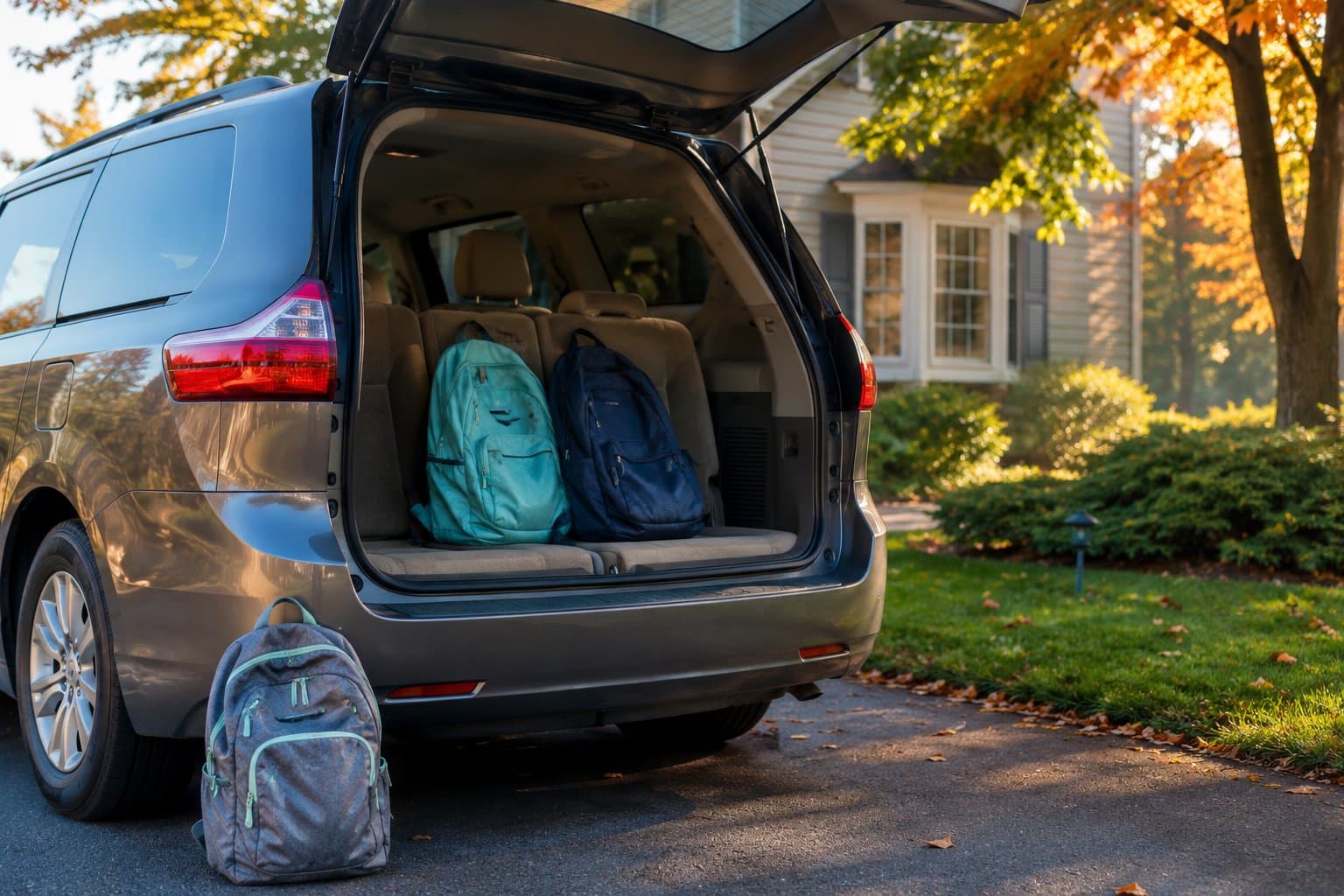
The school year changes how your car gets used. Same driveway, same route, but now it's dark at drop-off, there are children on foot at every corner, and the trip is four miles instead of forty.
Short trips in low light are less forgiving of the small things you've been meaning to get to. A headlight that's gone dim, a wiper that smears, a brake that squeals a little at the bottom of the hill — none of it matters much on a bright July afternoon. It matters a lot at 7:10 on an October morning with kids crossing in front of you.
This back-to-school car safety checklist covers what's worth looking at before the first week, and what belongs at a shop. If your teen is the one driving now, the last section is for you.
Figures below reflect data from the National Highway Traffic Safety Administration (NHTSA), AAA, the Insurance Institute for Highway Safety (IIHS), and car seat manufacturers. Your owner's manual is the final word for your specific vehicle.
Start Your Back-to-School Car Safety Checklist With the Lights
Lights change more between summer and the school year than anything else on the car, and they're what nobody thinks about until something is fully burned out.
Here's why the timing matters: NHTSA found that among school-age pedestrians killed in school-transportation-related crashes, more died between 6 and 8 a.m. and 3 and 5 p.m. than in any other hours — and two-thirds were children between 5 and 11 years old. Those are exactly the hours you're driving, and by late fall the morning half of that window is dark.
Check that everything works. Park facing a garage door and have someone stand outside while you run through low and high beams, brake lights, turn signals, reverse lights, and hazards. A burned-out bulb is invisible from the driver's seat. Bulbs run $10 to $40, and many parts-store counters will put one in for you.
Then look at the lenses themselves. If your car is more than about seven years old, the plastic headlight covers have probably gone cloudy or slightly yellow. AAA tested this and found that clouded, yellowed headlights put out roughly 20 percent of the light a new set does. Not 20 percent less — 20 percent of it. The bulb is fine; the lens has hazed over from years of sun, and you've been losing night vision so gradually there was never a moment it seemed to change.
The fix is cheap: a DIY restoration kit is $10 to $35 but needs redoing every few months, and professional restoration runs $100 to $150 per pair and holds two to three years. Either beats replacement lenses at around $150 each.
Brakes Work Harder on the School Run
School-year driving is stop-and-go by nature: bus stops, crossing guards, a drop-off line where you creep forward for ten minutes. That's the pattern brake pads wear fastest under.
You can't see the pads without pulling a wheel, but you can hear and feel plenty. A high squeal that comes and goes is usually the wear indicator doing its job — a small metal tab designed to make noise when the pad gets thin. A grinding or scraping sound means the pad is gone and metal is on metal: that's a same-week appointment, and so is a pedal that feels soft, sinks toward the floor, or shudders when you slow down.
Pad replacement runs $150 to $300 per axle, or $300 to $600 if the rotors need doing too — and waiting for the grinding is usually what turns the first number into the second. Many shops inspect brakes free, worth asking for when the car is already on a lift for an oil change.
Tires and Wipers Before the Weather Turns
Both are quick, and you can settle them in the driveway this weekend.
Tires. Wet leaves and early-season rain ask more of your tread than dry summer pavement does. The legal minimum is 2/32 of an inch, but grip in the rain falls off well before that, so aim to replace at 4/32". Pressure also drops about 1 psi for every 10 degrees the temperature falls, so the number that was right in August will be low by October — Tire Pressure Matters More Than You Think covers why that adds up.
Wipers and washer fluid. Blades last 6 to 12 months before the rubber hardens and starts streaking. If yours chatter, skip, or leave a haze that turns into blinding glare against a low autumn sun, replace them — a pair runs $20 to $50 and clips on without tools. Top off the washer fluid while you're there and keep a spare jug in the trunk, because a dry reservoir on a glare-y morning is genuinely dangerous.
The Car Seat Date Nobody Checks
Here's the one most parents have never heard: car seats and boosters expire. Manufacturers stamp a date on the shell or the underside, typically six to eight years from the date it was made — not the date you bought it, which could be a year or more later. Plastic gets brittle with heat cycling, harness webbing loses strength, and the safety standards the seat was built to move on.
Go look at yours. It takes a minute, and if the seat was bought used or handed down from an older cousin, the odds it's already past date are real.
Two NHTSA thresholds worth knowing while you're back there: a child stays in a booster until at least age 8, unless they're already 4 feet 9 inches tall — most need one until somewhere between 8 and 12 — and children under 13 belong in the back seat.
This is a good one to hand to a pro, and it's free. Certified child passenger safety technicians check seats at fire stations, police departments, and hospitals nationwide, and Safe Kids coalitions run thousands of free inspection events a year. If you've ever tightened a seat and wondered whether it was tight enough, that's worth twenty minutes of someone else's time. NHTSA's inspection station locator will find one near you.
If Your Teen Is Driving This Year
New drivers are the highest-risk group on the road, and they usually get the oldest car in the family. NHTSA reports that drivers 15 to 20 made up 5 percent of licensed drivers but nearly 9 percent of drivers in fatal crashes. IIHS research adds the part parents don't expect: among teen drivers killed in crashes, about two-thirds were in vehicles 6 to 15 years old — built before side airbags, stability control, and automatic emergency braking became standard.
You may not be able to change which car your teen drives. You can make sure it's the best-maintained one in the driveway rather than the most neglected — and it's worth saying out loud that a new driver has no baseline for what their car normally sounds like, so a noise that would make you slow down doesn't register with them at all.
Set the car up in Mintain under its own name, add the Oil & Filter Change, Tire Pressure Check, Brake Pad Inspection, and Battery Load Test templates, and let the notifications go to their phone. Add Registration & Insurance Renewal too — annual, and easy for a household with two more cars in it to lose track of. It hands a sixteen-year-old a system for something nobody otherwise teaches them.
And if a warning light neither of you recognizes comes on, our plain-English guide to dashboard lights sorts out which ones can wait until Saturday and which mean pulling over.
When to Call a Pro
Most of this list is looking and listening. Three findings belong at a shop rather than in your driveway: any brake noise or soft pedal, a puddle under the car, and headlights that still seem dim after new bulbs — aim drifts over the years and is adjustable, cheap, and a few minutes' work.
If you'd rather have the whole car gone through at once, most shops run a safety inspection for $50 to $100, and some do a basic check at no charge. And if there's a longer haul coming over fall break, our road trip car checklist covers the extra items highway miles call for.
Put the School Year on a Schedule
The reason these things slip isn't that they're hard. It's that August is the busiest month of the year in a house with kids, and a headlight that's been dimming for four years doesn't pick that week to announce itself.
That's what Mintain is for. Add each vehicle, apply the Exterior Light Check, Wiper Blade Replacement, Tire Tread Depth Check, and Brake Pad Inspection templates, and add your car seat's expiration as a custom task so it surfaces before the seat ages out instead of after. Mintain reminds you ahead of each one and keeps the history.
Free for up to 4 items, so one car and a car seat cost you nothing. Pro is $1/month or $10/year if you're tracking the whole driveway.
Add your vehicle to Mintain at mintain.app →
Handle it this week, and the darkest mornings of the year will find your car ready for them.
This is part of Mintain's weekly maintenance blog. Every Monday, we publish a new guide to help you stay ahead of home, auto, yard, and equipment maintenance — so nothing catches you off guard.