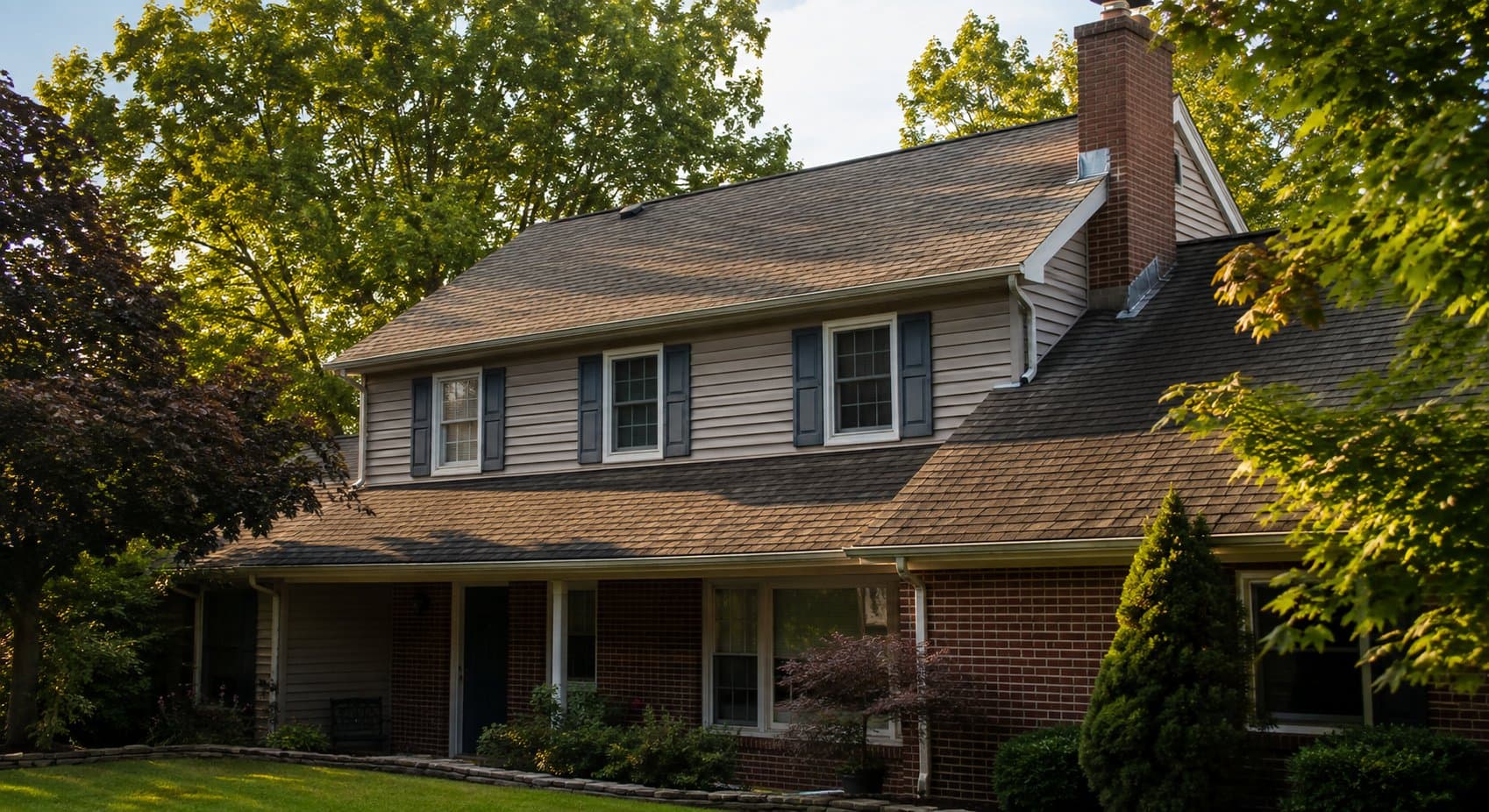
Most of your house tells you when something is wrong. The furnace makes a noise. The water heater leaves a puddle on the floor. The roof says nothing at all — until there's a brown ring on a bedroom ceiling, and by then the water has been getting in for months.
That silence is the whole problem, and it's why a roof inspection is worth putting on a schedule instead of waiting for a reason. How often you need one is a smaller number than most people expect, and a surprising amount of it you can do yourself from the driveway.
Late August is the right week for it. You're past the summer storms and ahead of the first freeze, and anything you find still has room to get fixed before winter.
Figures below reflect data from the National Roofing Contractors Association, This Old House, InterNACHI, peer-reviewed injury research, and current contractor pricing surveys. Your own policy documents and roof warranty are the final word for your house.
How Often a Roof Inspection Should Happen
Once a year, at minimum. That's the baseline most experts land on, and it's the interval a professional inspection is priced around.
Twice a year is the stronger recommendation — spring and fall — which is what the National Roofing Contractors Association has long advised. Spring catches what winter did: ice, wind, the weight of wet snow. Fall catches what summer did and gets it fixed before the weather turns.
And after any major storm, regardless of when you last looked. High wind, hail, and heavy snow lift shingles and crack seals, and hail damage in particular can sit invisible for a season before it shows up as a leak.
That last one has a deadline attached. Your window to file a storm claim varies by carrier — many policies allow a year, some as little as 60 days — and the clock generally starts on the date of the storm, not the date you noticed. Looking within a week or two of a bad one is how you keep the option open.
What You Can See From the Ground
You do not need to be on the roof for this. A pair of binoculars and a slow walk around the house covers most of what matters, and you should do a lap of all four sides — the slope facing away from the street is the one that goes unwatched for years.
Look at how the shingles lie. Healthy ones sit flat. A roof near the end of its life curls up at the corners, cups in the middle, or claws downward at the edges. Late-afternoon light is best for this because low sun throws a shadow off anything that isn't flat. One bad patch is a repair; curling across a whole slope is the roof telling you it's finished.
Look for gaps and dark patches. Missing shingles are obvious. Bald spots where the surface has gone dark and smooth mean the protective granules have worn off and the asphalt underneath is exposed to sun.
Look at the roofline itself. It should be straight. A dip, sag, or wave along the ridge is a structural finding, not a shingle finding, and it goes to the top of the call-a-pro list.
Then check your gutters. Granules that look like coarse black sand collect in the gutters and at the bottom of downspouts. A little is normal on a new roof and after storms. Handfuls of it, back again every time it rains, means the shingles are shedding their surface faster than they should — one more reason twice-yearly gutter cleaning is worth seeing with your own eyes.
The Attic Tells You More Than the Roof Does
If you have an accessible attic, this is the highest-value fifteen minutes in the whole job — you're looking at the underside of the roof deck, where problems appear long before they reach a ceiling downstairs.
Go up on a bright day and turn your flashlight off. Daylight coming through anywhere it shouldn't means water has a path too.
Then turn it back on and check the underside of the sheathing and the rafters for dark staining, streaks, or spots of mold — moisture that's been present long enough to start decaying the wood. Wet or matted-down insulation says the same thing. If you find a stain, follow it uphill: water runs along the framing before it drips, so the entry point is almost always higher than the mark.
Do this after a heavy rain if you can. An active leak is much easier to find while it's wet.
Leaks Rarely Start Where You'd Guess
Water almost never comes through the middle of a shingle field. It comes in where the roof is interrupted, and those are the spots worth pointing your binoculars at:
- Flashing — the metal that seals the joints where the roof meets a chimney, a wall, or a dormer. Failed flashing is one of the leading causes of roof leaks.
- Valleys — where two slopes meet. They carry the most water and collect the most debris.
- Vent boots — the rubber collars around plumbing vents. Sun degrades rubber, and these crack years before the shingles around them wear out. If your dryer vent exits through the roof rather than a sidewall, that hood belongs on the list too.
- Skylights, for the same reason as flashing.
The good news is that these are repairs, not replacements. A cracked vent boot caught in August is a modest bill. The same boot found in February, after a winter of dripping onto insulation, is a much bigger one.
How Old Is Your Roof?
Age is the fact that changes the conversation, because it determines whether what you're looking at is worth repairing at all.
Rough service lives, assuming decent installation and attic ventilation:
- 3-tab asphalt shingles: 15–20 years
- Architectural (dimensional) asphalt shingles: 20–30 years
- Wood shake or shingle: 25–40 years
- Metal: 40–70+ years
- Clay or concrete tile: 50–100 years
- Slate: 75+ years
One caution on shingles: the "30-year" rating printed on a bundle comes from lab testing, not from your roof. Real-world life runs shorter in hot climates, on poorly ventilated attics, and anywhere hail is routine.
There's a second reason to know the number, and it catches people off guard. Insurers have grown much stricter about roof age. Many carriers now require an inspection or certification once a roof passes about 15 years, and around 20 years it's common for coverage to shift from replacement cost to actual cash value — meaning a claim pays the depreciated value rather than what a new roof costs. Some decline to renew older roofs entirely. Thresholds vary by carrier and state, so read your own declarations page and find out which basis your roof is covered on before you need to know. For scale, a full asphalt replacement runs roughly $9,000 to $16,000, with a national average near $12,000.
What a Pro Costs, and When to Stay Off the Ladder
A standard visual roof inspection runs $150 to $400, with the national average around $250 to $330, and takes 45 minutes to a few hours depending on size and access. Drone inspections land in a similar range and suit steep or high roofs. Infrared scanning, which finds trapped moisture under the surface, runs $400 to $700 and is usually for diagnosing a known problem.
Call someone when you find a sag in the roofline, an active leak or attic stain, missing shingles or damaged flashing, curling across a whole slope, or storm damage you might file a claim on. Also call at the ten-year mark on an asphalt roof even if nothing looks wrong, and before you buy or sell a house.
And the honest part about the DIY half: stay on the ground. Ladder injuries treated in U.S. emergency rooms average well over 100,000 a year, most outside any workplace — and a roof adds pitch, granules that roll underfoot, and an edge you can't see over. A roofer up there is insured, tied off, and doing it for the fortieth time this month. Binoculars from the driveway and a flashlight in the attic get you most of the information at none of the risk.
Put the Roof on a Schedule
Roofs get neglected because they give you nothing to react to — no noise, no smell, no puddle — so there's never an obvious week to deal with it, and then there's a stain on the ceiling.
So give it a date instead of a reason. Add your house under the Home category in Mintain and apply the Roof Inspection template, set to annual or moved to every six months for the spring-and-fall rhythm. Pair it with Gutter Cleaning and, if you have a fireplace, Chimney Inspection & Cleaning — three exterior jobs that belong in the same walk-around, and three that are easy to lose a year to. Mintain reminds you before each is due and keeps the history, so when a contractor or an adjuster asks when the roof was last looked at, you have an actual answer.
Free for up to 4 items, so your house and a few other things cost you nothing. Pro is $1/month or $10/year if you're tracking more.
Start tracking your home in Mintain at mintain.app →
Twenty minutes in the driveway this weekend, and the quietest part of your house stops being the one you know the least about.
This is part of Mintain's weekly maintenance blog. Every Monday, we publish a new guide to help you stay ahead of home, auto, yard, and equipment maintenance — so nothing catches you off guard.