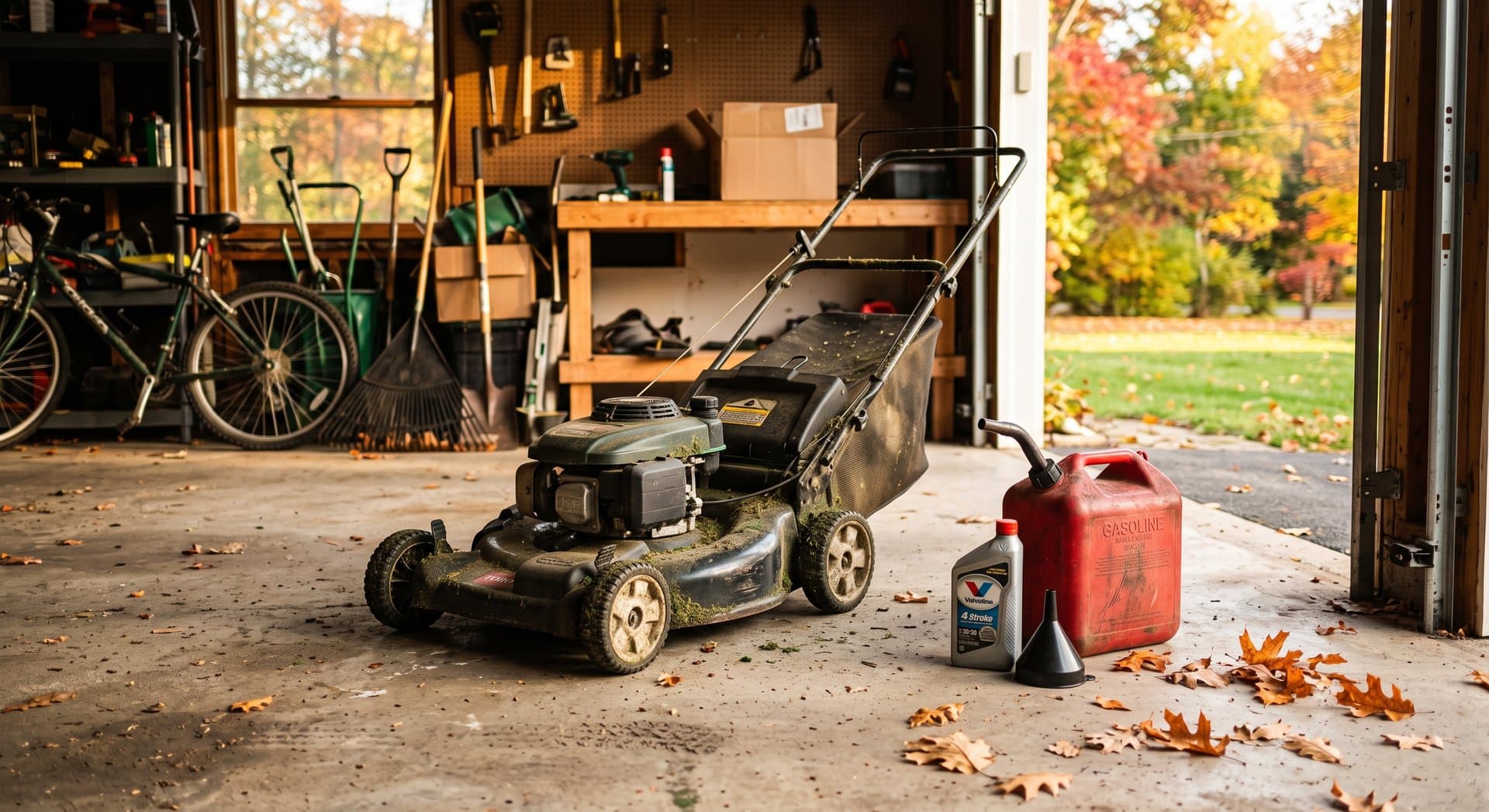
Nobody plans the last mow of the year. You cut the grass one Saturday in October, roll the mower back into the garage, and that's the last decision you make about it until the first warm weekend in April — when you find out how that October went.
Lawn mower end of season maintenance has an odd property: almost everything that goes wrong over the winter is decided in the twenty minutes after that last cut. Old fuel turning to varnish in the carburetor. Used oil sitting on bearings for six months. Wet grass welded to the underside of the deck. None of it announces itself in October. All of it shows up in April.
It's also the cheapest maintenance there is, because you're not fixing anything yet — you're just not leaving problems to sit. Late August is early for it, which is the point: you have a month or two of mowing left, and time to book a shop before everyone else needs one.
Guidance below reflects manufacturer recommendations from Briggs & Stratton, along with fuel and fire-safety guidance from established home and industry sources. Your owner's manual is the final word for your machine.
Fuel: The One Decision That Decides Next Spring
This is the item that strands more mowers than everything else combined. Pump gas containing ethanol — which is most of what's for sale — starts to break down in as little as 30 days, and after two or three months untreated it leaves gum and varnish in the narrow passages of a carburetor. That's the "it won't start" you meet in spring.
You have two legitimate options, and manufacturers and mechanics genuinely disagree about which is better.
Option one: stabilize and top off. Fill the tank with fresh gas treated with fuel stabilizer, then run the engine a few minutes so the treated fuel reaches the carburetor — untreated gas sitting in the carburetor bowl is the part that causes trouble. Stabilizer keeps fuel usable for 12 to 24 months depending on the product, and a full tank leaves less room for condensation.
Option two: drain it dry. No fuel means no fuel to go stale. The trade-off is that an empty system invites moisture and can dry out rubber seals. If you go this route, get it all out rather than leaving an inch in the bottom.
Either works. What doesn't work is the third option most of us pick by default — leaving half a tank of untreated summer gas in there until April.
Change the Oil While the Engine Is Still Warm
Used oil isn't just dirty. Combustion leaves moisture and acids behind in the crankcase, and over six idle months those sit against bearings and cylinder walls and slowly etch them. Fresh oil also carries rust inhibitors that spent oil has used up.
Do it right after your last cut, while the engine is still warm. Warm oil is thinner, drains faster, and carries the settled grit out with it instead of leaving it in the bottom of the pan.
Oil for a walk-behind mower runs $5 to $10; a riding mower holds more and has an actual filter, closer to $20 to $35 in parts. Use the grade your manual specifies.
Clean the Deck and Settle the Blade Question
Grass clippings packed under the mowing deck hold moisture against bare metal all winter, and that's how a deck rusts through years before the engine wears out.
Pull the spark plug wire first — always, before your hands go anywhere near the deck. Scrape the buildup off with a wooden stick or plastic scraper rather than your fingers, hose the deck down, and let it dry completely before it goes into storage.
While you're under there, look at the cutting edge. A blade that's dull or lightly nicked can be sharpened — a shop will sharpen and balance one for $10 to $15. A blade that's bent, cracked, or worn thin at the edge gets replaced, at $15 to $40, and never sharpened; a bent blade throws the deck out of balance and pushes that vibration straight into the spindle and engine.
Riding Mowers: Get the Battery Out of the Cold
A lead-acid battery left partly discharged through a cold winter sulfates, and sulfation permanently costs it capacity. That's why so many lawn tractors need a jump — or a new battery — the first warm weekend.
Charge it fully before the machine goes away. Then either disconnect the negative cable and bring the battery into a cool, dry spot indoors, or leave it in place on a battery maintainer — a float-mode charger built to stay connected for months without overcharging. At $25 to $50, one pays for itself the first time it saves a $30 to $80 battery.
Where You Park It Matters More Than You'd Think
Gasoline vapor is heavier than air. It sinks, spreads along the floor, and can find an ignition source well away from the machine it came from. In an attached garage or basement, that ignition source is usually a water heater, furnace, or gas dryer with a standing pilot light — sitting at floor level, burning, all winter.
So park the mower away from those appliances, not beside them. Gas cans are the bigger hazard of the two and belong in a detached shed or garage where that's practical, in an approved container, out of direct sun. And wherever it ends up, the room needs to be dry.
When to Hand It to a Shop
If you'd rather not do any of this, fall is the smart time to say so. Small engine shops are buried in April and quiet in October — you get an appointment instead of a two-week wait, and shops clearing the fall calendar are the likeliest to discount. A basic walk-behind service runs about $40 to $120; a full riding mower tune-up runs $150 to $250, as covered in our riding mower maintenance guide.
Take it in — rather than storing it and hoping — if it was already running rough, surging, or hard to start this season. A carburetor struggling in September will not improve over six months of sitting.
Your string trimmer and chainsaw have the same fuel problem on the same schedule.
Put Lawn Mower End-of-Season Maintenance on a Schedule
Back in April we promised this post to everyone catching up on fall maintenance they'd skipped. Here it is — and remembering in October is the entire trick. Nobody forgets a mower in spring; the grass reminds you. Fall gives you no reminder at all.
So put it on a schedule instead. Add your mower under the Yard category in Mintain and apply the Fuel Stabilizer / Tank Drain, Engine Oil Change, Blade Sharpen / Replace, and Air Filter Replacement templates — plus Battery Maintenance (Pre-Storage) on a riding mower. Mintain tells you before the machine goes into the garage, not after.
Free for up to 4 items. Pro is $1/month or $10/year if you track more.
Add your mower to Mintain at mintain.app →
Twenty minutes after the last cut of the year buys you a mower that starts on the first pull in April — and that's a genuinely good trade.
This is part of Mintain's weekly maintenance blog. Every Monday, we publish a new guide to help you stay ahead of home, auto, yard, and equipment maintenance — so nothing catches you off guard.