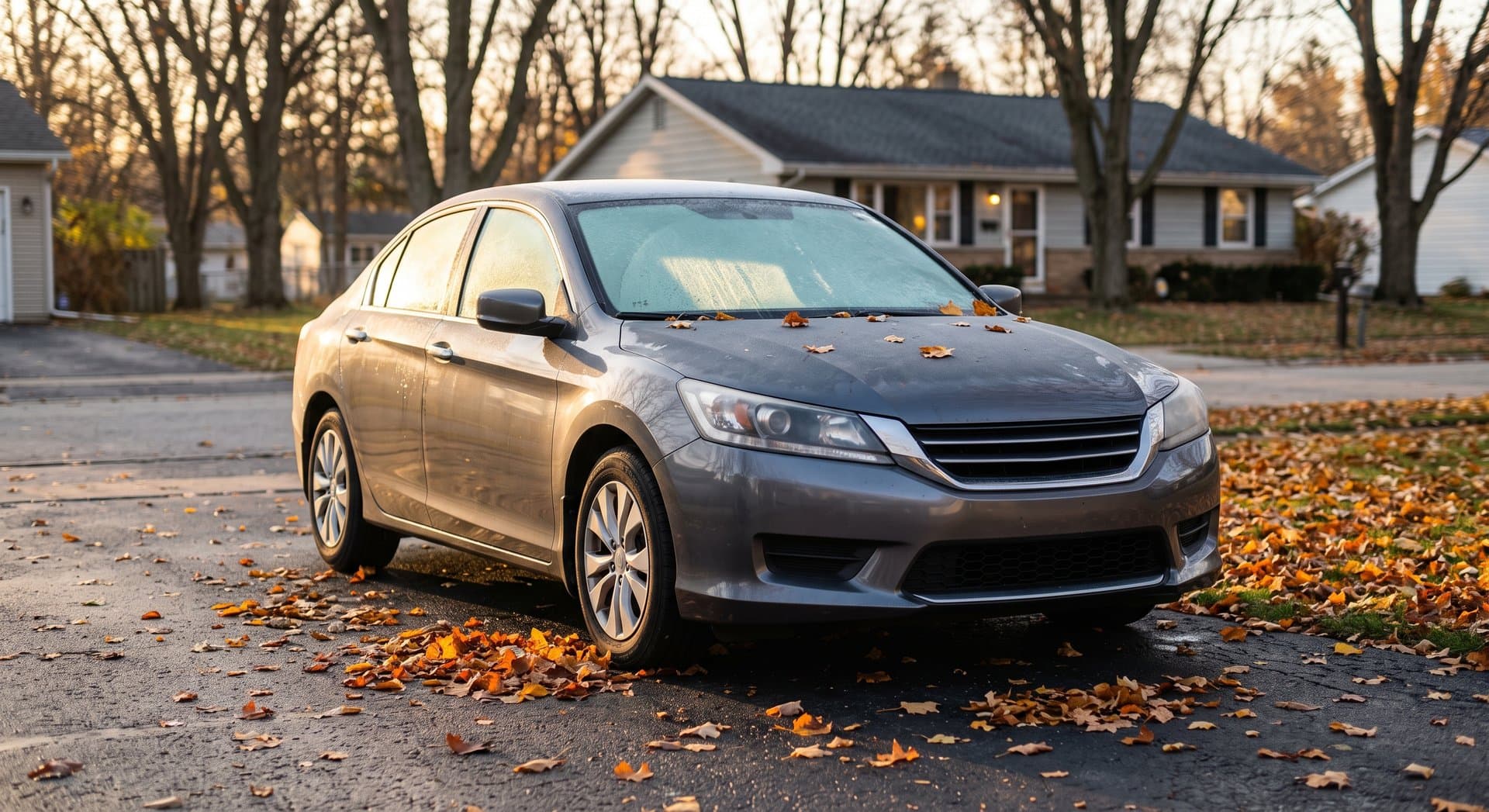
Nothing about your car changes on the first cold morning of the year. What changes is everything it's being asked to do — and the parts that were quietly getting weaker all summer are the ones that get asked first.
That's the pattern behind almost every fall breakdown. A battery that started the car fine in August is asked to turn a cold engine in November. Washer fluid that worked all summer sits in a reservoir below freezing. Tires set correctly in July run low because the air in them got cold.
None of it announces itself. These fall car maintenance tips cover the five things worth checking in September, while it's still pleasant to stand in the driveway — and which ones belong at a shop instead.
Figures below reflect data from AAA, State Farm's animal collision claims analysis, RepairPal service estimates, and current 2026 shop pricing surveys. Your owner's manual is the final word for your specific vehicle.
The Battery Is the One That Strands You
Cold weather does two things to a battery at once, and they work against each other.
It takes away the battery's power. At 32°F, a car battery loses about 35 percent of its strength. At 0°F, it's down about 60 percent. Cold slows the chemical reaction inside the battery, and there's nothing you can do about it.
And it raises what the engine needs. Cold motor oil is thicker, so the starter works harder to turn the engine over — up to twice the current of a summer start. Less available power, more power required. That's why a battery that's been merely tired for six months dies on one specific cold morning and not before.
Most batteries last three to five years. If yours is in that window, get it tested — most national parts stores do it free, in about five minutes, and check the alternator's output at the same time, so you learn whether the battery is actually the problem.
Before replacing anything, look at the terminals. Corrosion shows up as a white, blue, or green powder around the posts, and it adds enough resistance to cause weak starting on a perfectly good battery. Cleaning the posts and tightening the connections sometimes solves the whole thing.
Replacement runs $100 to $350 installed, most people paying $150 to $250. Parts stores typically install free; an independent shop adds around $45, a dealer around $95.
Antifreeze: Check the Protection, Not Just the Level
Coolant does two opposite jobs — it keeps the engine from boiling in July and from freezing in January — and it's the second one that goes unverified for years.
A proper 50/50 mix of antifreeze and water protects to about -34°F. Coolant topped off with plain water over the years is weaker than that, and nobody remembers doing it. A shop can test the freeze point in a minute or two with a hydrometer, usually as part of a service you're already paying for. Ask for the number.
Replacement intervals vary more than almost anything else on a car. Conventional green coolant generally wants changing every 2 to 3 years or about 30,000 miles; many modern vehicles ship with long-life coolant rated for 5 years or 100,000 miles, and some go further. The owner's manual genuinely matters here — the range is too wide to guess at.
A full flush runs $100 to $200 at an independent shop, $200 to $400 at a dealer or for European vehicles needing a specific coolant. A drain-and-fill is cheaper at $50 to $100 but replaces only about half the fluid.
One safety note that matters more than the rest of this section: check your coolant level at the plastic overflow reservoir, with the engine cold. Never open a radiator cap on a warm engine. The system is pressurized, and the fluid inside is well above boiling.
Fall Car Maintenance for Tires: The Cold Takes Your Pressure
Tire pressure falls about 1 psi for every 10 degrees the temperature drops — the reason a set you filled correctly in summer reads low by late October, without a single leak. We covered why that matters for grip and fuel economy in Tire Pressure Matters More Than You Think.
What's new in the fall is the dashboard. The tire pressure light comes on during the first genuinely cold mornings every year, and the pattern tells you which problem you have:
- It comes on cold, then goes out after 20 minutes of driving. That's temperature. The air warmed and expanded. Your tires want air, but nothing is wrong with them.
- It stays on after the tires have warmed up. That's a leak or a real underinflation, and it's worth having looked at this week.
Either way, add air. Check before you drive rather than after, and use the number on the sticker inside the driver's door — not the one molded into the sidewall, which is the tire's maximum, not your car's target. Wet leaves and cold rain also ask more of your tread than dry summer pavement, so this is a good weekend to look at depth as well.
Visibility Before the Clocks Change
Daylight saving time ends Sunday, November 1 this year, which turns the evening drive home dark more or less overnight. Two things are worth handling before then.
Switch your washer fluid. All-season and summer blends are mostly water and begin freezing around 32°F. Winter formulas stay liquid to -20°F or lower. This isn't only about a frozen sprayer on a bad morning — fluid that freezes in the reservoir can crack it or damage the pump. Run the level down before refilling so you're not diluting the new fluid with the old.
Then handle the wipers and lights together, since they fail on the same mornings. Our back-to-school car safety checklist covers both in detail, including why headlights on a car older than about seven years are dimmer than you think.
Here's the argument for doing it before November rather than during it: October, November, and December account for about 41 percent of all animal collision claims — an estimated 650,000 incidents, with November the single worst month. Deer move most at dawn and dusk, the same hours that just went dark. Clean glass and full-strength headlights are the cheapest safety equipment on the car.
The Defroster Problem That's Actually a Filter
Every fall, a windshield that used to clear in a minute starts taking five, and almost nobody traces it to the right part.
Your defroster pushes air through the cabin air filter on its way to the glass. When that filter clogs, two things happen at once: less air reaches the windshield, and the air that does arrive is wetter, because the system had less airflow to dry. Weak defrost, slow clearing, and glass that fogs back up are the classic symptoms.
Most manufacturers call for replacement every 12 months or 12,000 to 15,000 miles. Shop replacement averages $91 to $113, with a range of $45 to $150 depending on the vehicle. On many cars the filter sits behind the glovebox, and a shop will swap it in a few minutes while your car is in for something else.
When to Call a Pro
Most of this is looking, listening, and adding air. Four findings belong at a shop:
- The engine cranks slowly or clicks, but the battery tests fine. That points at the starter, the cables, or the charging system.
- Coolant that's rusty, oily, or repeatedly low. Low coolant that keeps coming back is a leak, and finding one costs far less than an overheated engine.
- Heat that never gets hot, or a defroster still weak after a new cabin filter.
- Anything that requires opening the cooling system. Pressurized, hot, and not worth the risk.
And when a light you don't recognize comes on during any of this, our plain-English guide to dashboard warning lights sorts out what can wait for the weekend.
Put Fall on the Calendar Instead of the To-Do List
The reason these five things slip isn't that they're difficult. It's that each one fails on a schedule your car keeps and you don't. The battery has been weakening for three years. The coolant was last changed by whoever owned the car before you. There's no warning light for washer fluid that's about to freeze.
That's the gap Mintain fills. Add your vehicle, apply the Battery Load Test, Battery Terminal Cleaning, Coolant / Antifreeze Flush, Cabin Air Filter Replacement, Tire Tread Depth Check, and Windshield Washer Fluid templates, and shift the annual ones to September so they land before the weather does. Mintain tracks mileage as well as time, so each interval follows whichever comes first — and if your manual says 5 years where the template defaults to 2, change it once and it stays changed.
Free for up to 4 items, so one car costs you nothing. Pro is $1/month or $10/year if you're tracking the whole driveway.
Add your vehicle to Mintain at mintain.app →
Spend an hour on it this month, and the first hard freeze becomes a weather event instead of a car problem.
This is part of Mintain's weekly maintenance blog. Every Monday, we publish a new guide to help you stay ahead of home, auto, yard, and equipment maintenance — so nothing catches you off guard.