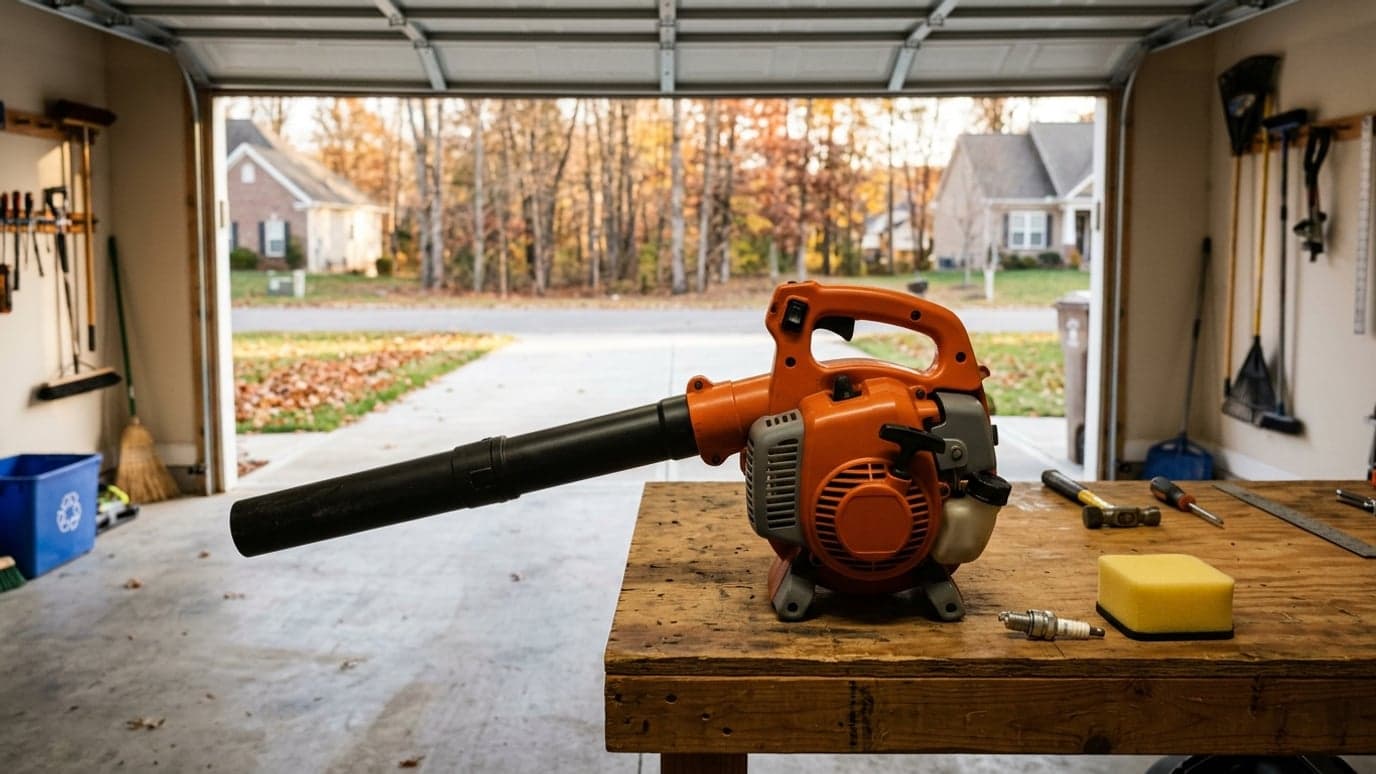
The leaf blower usually gets put away in a hurry. The last pile is cleared, your hands are cold, and it goes on a garage shelf with whatever gas is still in the tank. Months later, it won't start.
An end-of-season leaf blower maintenance service fixes that, and it's a short job. Most of it is about what the blower sits with over the winter: old fuel, a dirty filter, a battery left in a cold garage. Ten or twenty minutes now saves a trip to the repair shop in spring.
This post covers the end-of-season service for gas, battery, and corded blowers, plus the extra checks a blower/vac needs, and when to hand it to a shop.
Guidance below reflects owner's manuals and published recommendations from STIHL, ECHO, Husqvarna, and Toro, along with Consumer Reports' battery storage advice. Your owner's manual is the final word for your machine.
Gas Blowers: Deal With the Fuel First
Most handheld and backpack gas blowers run on a two-stroke engine, which burns a gas-and-oil mix. That mix doesn't keep well. STIHL's manuals say not to store mixed fuel longer than 30 days, and to avoid gas with more than 10 percent ethanol in most of its blowers.
For storage of 3 months or longer, STIHL's instructions are clear:
- Drain the fuel tank into an approved container, in a well-ventilated spot.
- Start the engine and let it run until it stops on its own. Running the carburetor dry keeps its small internal parts from gumming up and sticking.
- Dispose of the old fuel properly. Many local household hazardous waste sites take it.
ECHO allows an alternative: an empty tank or fuel treated with stabilizer. If your manual offers both, either works. Draining is the safer bet for a blower that will sit until next fall.
If your blower has a four-stroke engine (the manual will say), it also has engine oil to change, the same way a mower does. Our string trimmer guide explains why two-stroke fuel is so fussy, if you want the longer version.
The Leaf Blower Maintenance Service Checklist
With the engine off and cool, go through four parts. On most blowers, you can reach all of them without special tools.
Air filter. Leaves and dust get pulled toward the air intake all season. A clogged filter makes the engine harder to start and weaker. Foam filters can usually be washed in mild soapy water, squeezed out, and dried completely. STIHL advises against blowing them out with compressed air, which can damage the material. A filter that's torn or won't come clean gets replaced, usually for a few dollars.
Spark plug. STIHL calls for a new plug after about 100 hours of running time, or sooner if it looks worn or corroded. Most homeowners don't come close to 100 hours in a year, so pulling the plug for a look each fall is usually enough. Replace it if the tip is black and crusty or worn down.
Fuel filter. This is a small weight on the end of the fuel line, inside the tank. ECHO says to replace it as needed, and a yearly check is a sensible habit. Fishing it out can be a little fiddly, so many people leave it for the shop.
Spark arrestor screen. Many blowers have a small screen inside the muffler that catches hot sparks. If your blower starts fine but feels down on power, even with a clean air filter, a screen clogged with carbon is a common cause. STIHL recommends having the muffler checked by a dealer rather than taking it apart yourself. Never run the blower with the screen missing or damaged.
Clean It Before It Goes on the Shelf
Husqvarna lists "storing the blower while dirty" as one of the most common storage mistakes. Dirt and damp leaves hold moisture against metal parts all winter.
- Wipe down the housing and clear leaf bits from the air intake and cooling vents. On gas models, STIHL calls out the cylinder fins (the ridged metal around the engine) as the spot to clean.
- Look over the blower tubes. Cracks or loose connections waste air.
- Check the starter cord for fraying, and tighten any loose screws. A season of shaking can work them free.
- Store it somewhere dry, off the floor and away from children. A shelf or wall hook works well.
Battery and Corded Blowers
Battery blowers skip the fuel step, but the battery needs its own care. Consumer Reports' advice for outdoor tool batteries that will sit 30 days or longer:
- Bring the battery indoors, even if the blower stays in the garage. STIHL warns that a battery left in freezing temperatures can be ruined.
- Store it at about 40 percent charge, not full and not empty.
- Keep it between 40°F and 80°F. A closet or basement shelf is usually fine.
Brands differ on mid-winter top-ups. Some batteries need a charge every couple of months, and others don't. Check your manual.
For corded blowers, Toro's fall advice is to check the extension cord before the season. A cord with cracked or nicked insulation should be replaced, not taped.
Blower/Vacs: The Impeller and the Bag
If your blower converts to a leaf vacuum, it has a few more parts to check. The impeller is the fan inside that pulls leaves in and chops them up.
Safety first. Toro's rule: when clearing a clog or switching between blower and vacuum mode, turn the unit off, unplug it, and wait for the impeller to stop spinning. On a gas model, pull the spark plug wire. Never reach into the intake with your hand.
Then check:
- The impeller. Look for chipped or cracked blades. Stones, gravel, and bits of metal or glass picked up with the leaves can badly damage it, and a damaged impeller moves less air.
- The inlet cover. Toro says to replace it if it's broken or cracked. It's the guard that keeps fingers away from the impeller in blower mode.
- The bag. Empty it, shake it out, and let it dry completely before you fold it away. Use only the bag made for your model.
Walk-behind or tow-behind leaf vacuums usually run on a mower-style engine, so their engine service follows our end-of-season mower guide.
When to Take It to a Shop
Hand it over, rather than keep pulling the cord, if:
- It won't start on fresh fuel after you've checked the plug and air filter.
- It surges, bogs down, or only runs with the choke on. That usually points to the carburetor.
- The impeller is chipped, or anything is leaking fuel.
Prices vary a lot by area. One small engine shop lists a leaf blower tune-up at about $55 in labor, with parts extra. Shops that bill by the hour often charge around $100 an hour, and some have a minimum fee to look at it at all. Parts for a basic tune-up (spark plug, air filter, fuel filter) usually run $20 to $30.
On an inexpensive blower that's several years old, a repair bill can come close to the cost of a new one. It's fair to ask the shop for an honest repair-or-replace opinion. Fall is also a good time to book, since shops fill up with snow blower tune-ups once the first storm is in the forecast.
Track Leaf Blower Maintenance in Mintain
The hardest part of leaf blower maintenance is remembering it on the one day you're finally done with leaves. That's what Mintain is for.
Add your blower under the Yard category and pick from the Leaf Blower templates:
- Fuel Stabilizer / Tank Drain: annually, at the end of leaf season.
- Air Filter Replacement: annually, with Air Filter Cleaning every month or 10 hours during the season.
- Spark Plug Replacement: annually or 100 hours.
- Spark Arrestor Screen Clean/Replace: every 6 months or 50 hours.
- Fuel Filter Replacement and Discharge Tube Inspection: annually.
If you have a blower/vac, add a custom yearly task called Impeller & Bag Check. Use the notes field for your spark plug part number, fuel mix ratio, and filter type, so next fall's service starts with the right parts.
Free for up to 4 items. Pro is $1/month or $10/year if you track more.
Add your leaf blower to Mintain at mintain.app →
Put it away clean, empty, and checked, and it'll be ready for the first leaves next fall. Next week: quick home checks before holiday guests arrive.
This is part of Mintain's weekly maintenance blog. Every Monday, we publish a new guide to help you stay ahead of home, auto, yard, and equipment maintenance — so nothing catches you off guard.