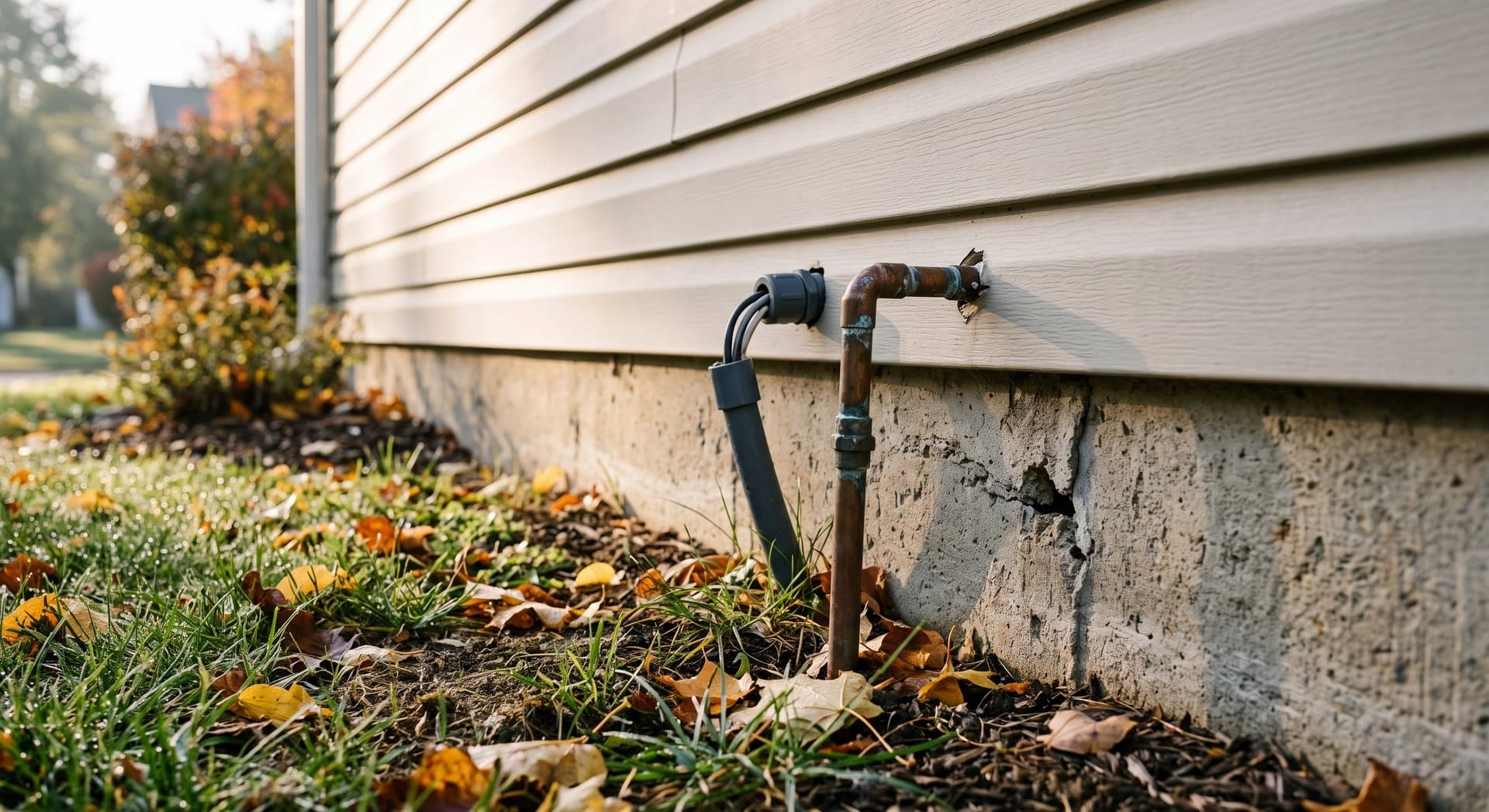
A mouse doesn't break into a house. It finds a gap that was already there — one you've walked past a thousand times without seeing — and around the first cool nights of September, it starts looking.
Pest-proofing your home before fall is mostly that: finding those gaps while it's still pleasant to be outside looking for them. It isn't spraying anything. It's a slow walk around the house with a flashlight and a clear idea of how small a hole has to be before it stops counting as a door.
Timing is the part worth getting right. Mice, stink bugs, cluster flies, and lady beetles all move toward warm buildings as nights cool, and the overwintering insects are heaviest from mid-August through October. Work done in early September closes doors before anyone is standing at them.
Guidance below reflects recommendations from Texas A&M AgriLife and Mississippi State Extension, University of Minnesota Extension, the CDC, and current pest control pricing surveys. Species and wildlife rules vary by state — a licensed pest or wildlife company near you is the final word for your house.
The Quarter-Inch Rule
Every decision in this job comes down to one number.
A mouse fits through a quarter-inch gap — the size of a dime. A rat needs about half an inch, roughly a quarter. Texas A&M AgriLife Extension puts it in coins for that reason; Mississippi State Extension says the same in fractions. A mouse's skull is the widest rigid part of it, and if the skull clears, the rest follows.
The useful consequence: seal to the mouse standard and everything bigger is covered. No separate plan for rats, squirrels, or chipmunks. One number, applied everywhere.
So carry a pencil. If a pencil slides into a gap, a mouse does too.
Pest-Proofing Your Home: Where to Actually Look
Start at one corner and work your way around, low to high. Most of what you'll find is in six places.
The foundation line. Where siding meets the foundation and where the foundation meets soil. Settling cracks, missing mortar, and gaps behind loose siding all show up here.
Utility penetrations. Anywhere something enters the wall — water and gas lines, electrical conduit, cable, the copper line set running to your AC condenser, exterior spigots. These are drilled oversize on purpose and often never sealed after.
The garage door. The rubber bottom seal flattens and cracks with age, and the two bottom corners are the classic gap. An attached garage is a hallway into the house.
Vents. Crawlspace and foundation vents with torn screen, soffit and gable vents, bathroom exhaust terminations. A dryer vent is a heated tunnel pointing outdoors — check that its flap still falls shut.
Weep holes in brick. The small vertical gaps in the bottom mortar course of brick veneer are deliberate, draining water out of the wall cavity. Do not caulk them. They need covers or mesh that stay open to airflow.
Doors and windows. Worn door sweeps, compressed weatherstripping, torn screens, and gaps where a storm door meets its frame.
Then look up — the roofline, soffit returns, the chimney, where downspouts meet gutters — from the ground, with binoculars. Anything that needs a ladder is worth pairing with your annual roof inspection rather than climbing for.
What Actually Holds
Materials matter more than effort here, because rodents chew.
Expanding foam and caulk alone won't stop a mouse. They chew through both. Foam is fine as a weather seal, but it needs something metal behind it.
Small gaps: copper mesh, packed tight, then sealed over. Rodents won't chew through metal fiber, and unlike steel wool, copper doesn't rust — so it survives outdoors and in damp crawlspaces instead of failing in a few seasons.
Holes three inches and up: quarter-inch hardware cloth, cut oversize, fastened down, then patched over. That's the standard for vents, larger foundation openings, and anywhere a pipe leaves a real hole.
Weep holes: stainless weep covers or a small wad of copper mesh — both block pests while letting water drain. A worn garage door seal has its own fix: a replacement bottom seal and threshold, stocked at any hardware store.
The Bugs Are a Different Problem
Stink bugs, boxelder bugs, cluster flies, and Asian lady beetles are what entomologists call overwintering pests. They gather on sunny south and west walls on warm fall afternoons, then work into the gaps as it cools.
They aren't damaging anything. They don't reproduce indoors, don't eat wood or food, and don't bite — they're dormant houseguests waiting for spring. But a brown marmorated stink bug passes through an opening as small as 3 by 7 millimeters, which is why sealing that stops mice won't fully stop them.
Skip the indoor sprays. University of Minnesota Extension is direct about it: pesticides are not recommended indoors for stink bugs. They work poorly on insects inside wall voids, and dead insects in walls attract other pests. Remove them with a vacuum or by hand instead — stink bugs release their odor when crushed or pulled through a vacuum, so use a shop vac you don't mind smelling.
One Rule About Sealing: Don't Close Anyone In
This is the mistake that turns a good weekend into a bad month.
If there are fresh signs of mice inside — droppings, chewed packaging, scratching in a wall at night — trap first, then seal. Sealing an active entry point traps animals in the wall or attic, where they die, smell for weeks, or chew a new hole outward. Trap until activity stops, then close the openings.
Bats are their own category, and the rules there are legal, not optional. Bats are protected, and exclusion is restricted during maternity season — roughly June through mid-August in most states, when flightless pups are in the roost. Fall is the correct window, but the work belongs to a wildlife professional who installs one-way doors before closing anything. If you have bats, call rather than caulk.
And leave an active wasp or hornet entrance alone. Plugging the hole doesn't trap them — it convinces them to find another way out, sometimes into the room on the other side of the wall.
The Half of the Job That Isn't on the House
Firewood belongs at least 20 feet from the house and 6 to 12 inches off the ground on a rack, blocks, or pallets. A woodpile stacked against the siding is a staging area with a view of your foundation.
Trim branches back 6 to 8 feet from the roofline. Overhanging limbs are a bridge that skips every ground-level thing you sealed.
Keep gutters and downspouts clear, and pull mulch and dense ground cover back from the foundation so you can see the bottom of your walls. A gutter packed with wet leaves is nesting material at roof height. If your gutter cleaning is already on the fall list, this walk-around belongs on the same weekend.
If You Find Droppings, Clean Them the CDC's Way
This one is a health matter, not a tidiness note.
Do not sweep or vacuum rodent droppings, urine, or nesting material. Both stir particles into the air, and that airborne dust is how hantavirus reaches people. Use the CDC's wet method instead: gloves on, spray the area with disinfectant or one part bleach to ten parts water, let it soak five minutes, pick it up with paper towels, bag it for the trash, then wipe the surrounding surfaces and wash your hands thoroughly.
A heavy accumulation in an attic or crawlspace is worth hiring out — cleanup in a confined, poorly ventilated space carries real respiratory protection requirements.
What a Pro Costs, and When to Call One
A one-time pest control visit runs $100 to $300, national average near $171. An initial inspection and treatment runs $150 to $300, and ongoing quarterly service $100 to $300 per visit — roughly $425 to $1,200 in the first year including that initial visit. Rodent-specific work runs $150 to $600, and full exclusion, where a company finds and seals every entry point on the structure, is quoted separately at $300 to $2,000 depending on the age of the house. On an older home with a stone foundation, that's often money well spent — the gap count is high and the gaps are awkward.
Call someone when: you have bats, an active wasp or hornet nest in a wall, scratching inside walls or ceilings, droppings accumulating faster than you can trap, or entry points in a crawlspace, attic, or anywhere needing a ladder. Also call if you've sealed carefully and they're still getting in — that means an opening you haven't found, and finding it is the service you're buying.
Put the Walk-Around on the Calendar
The reason this one gets skipped isn't difficulty. It's that nothing prompts it. No noise, no leak, no warning light — only a pleasant September weekend that passes, and then a January morning with droppings under the sink and no obvious way in.
So schedule it. Add your house under the Home category in Mintain and apply the Exterior Caulk & Weatherstripping Inspection and Foundation Walk-Around templates, both annual, timed to early fall so they land while the weather still cooperates. Pair them with Gutter Cleaning and Dryer Vent Cleaning — one lap around the house covers all four. If you use a pest company, add their visits as a custom task repeating quarterly, so you know when the last one actually happened.
The history matters more here than it sounds: next September you'll want to know which side of the house you sealed last year and which one you ran out of daylight on.
Free for up to 4 items, so your house and a few other things cost you nothing. Pro is $1/month or $10/year if you're tracking more.
Start tracking your home in Mintain at mintain.app →
Close the gaps in September, and the first cold night arrives without bringing anyone in with it.
This is part of Mintain's weekly maintenance blog. Every Monday, we publish a new guide to help you stay ahead of home, auto, yard, and equipment maintenance — so nothing catches you off guard.