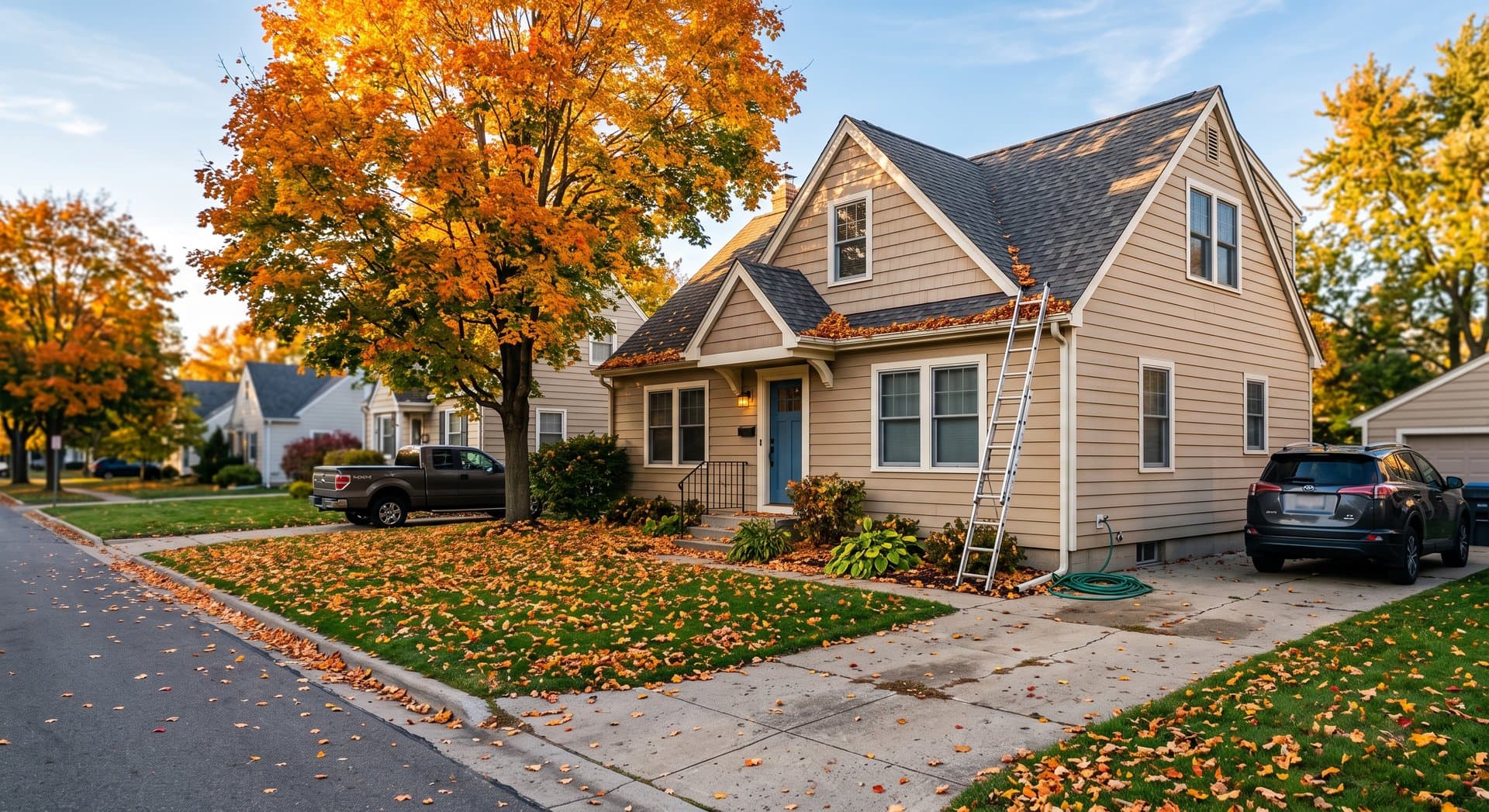
Your spring checklist is about what winter did to the house. Your fall checklist is about what winter is going to do — and this is the one time of year you get to go first.
Every task on a fall home maintenance checklist has the same shape. In September it's a phone call, a hardware store run, or twenty minutes with a flashlight. By January the same task is an emergency, and the person who fixes it is charging emergency prices because everyone on your street called the same week.
So this list is ordered by deadline, not by room. The items at the top have the earliest cutoff — a booked-solid HVAC calendar, the first fire, the first night in the teens. The ones at the bottom can wait for a Saturday in November.
In short: Book the furnace tune-up, get the chimney inspected, disconnect hoses and insulate exposed pipes, clean gutters after the leaves drop, look at the roof from the driveway, seal drafts, and change alarm batteries when the clocks fall back. Hired out entirely, the list runs roughly $500 to $1,600. About half of it needs no one but you.
Figures below reflect guidance from the U.S. Department of Energy, the NFPA, the Chimney Safety Institute of America, the Insurance Information Institute, the University of Illinois Building Research Council, and current 2026 contractor pricing surveys. Your climate — and your furnace's manual — are the final word for your house.
Book the Furnace Tune-Up Now, Because Everyone Else Will Later
HVAC companies call September and October the shoulder season: the air conditioning calls have stopped and the heating calls haven't started. Then the first cold snap arrives, every furnace in town gets switched on the same evening, and the ones that don't light all land on the same waiting list.
Heating is also the largest single line on most utility bills — about 29 percent, per the Department of Energy — so this is the appointment with the biggest payoff.
What it costs: A basic tune-up runs $80 to $150. A comprehensive one — burners cleaned, heat exchanger inspected, safety controls tested, and a carbon monoxide reading on the exhaust — runs $150 to $300. On a gas furnace, ask for the comprehensive version. The heat exchanger and CO checks are the safety part, and they need instruments you don't own.
What you can do: Replace the filter if it's been more than a couple of months (intervals are in How Often Should You Really Change Your HVAC Filter?), then run the heat for ten minutes on a mild afternoon. A faint burning-dust smell for the first few minutes is normal. A smell that persists, or anything like gas, means shut it off and call.
Chimney and Fireplace: Inspect Before the First Fire
If you burn wood, this has the hardest deadline on the list. The first cold evening is when people light a fire — and when a chimney nobody has looked at in three years finds out whether it's ready.
NFPA 211 calls for an annual inspection regardless of how much you use the fireplace, and the Chimney Safety Institute of America backs that. The reason is creosote, the tar-like residue wood smoke leaves on the flue. NFPA's analysis of home heating fires found that failure to clean — mostly creosote in chimneys — was the leading contributing factor, at 28 percent.
What it costs: A Level 1 inspection, the standard annual visual check, runs $75 to $250 depending on where you live. A sweep — the actual cleaning — averages around $254, most people paying $129 to $381. Many companies bundle the two. Heavy buildup from years of skipped cleanings runs $400 to $900 because it takes different tools.
One thing to do today: if the fireplace isn't in use, make sure the damper is closed. An open damper pulls heated air out of the house all winter.
This is a pro job, every year. You can't see the inside of a flue from the hearth, and creosote you can't see is the kind that matters.
The Fall Home Maintenance Checklist for Pipes and Spigots
Frozen pipes are the most expensive item on this page. The Insurance Information Institute puts the average water-damage-and-freezing claim at more than $12,000. The prevention is the cheapest item on the page.
Disconnect every garden hose. This is the one people skip, and the one that matters. A hose left attached traps water in the spigot, and when it freezes it can split the pipe inside the wall — where you won't find it until spring, when you turn the spigot on and hear water running somewhere it shouldn't. Frost-free spigots are not exempt: the design depends on the water draining out, and an attached hose stops it. If the spigot has an interior shutoff valve, close it and open the spigot to drain the line.
Insulate pipes in unheated spaces. Garage, crawlspace, exterior walls, the run to the water heater in an unfinished basement. Foam pipe sleeves cost $0.50 to $2.50 per foot and slide on without tools. The University of Illinois Building Research Council found that uninsulated pipes in unconditioned spaces begin freezing when the outdoor temperature falls to about 20°F — which is why that number, not 32°F, is the one worth watching in the forecast.
When to call a pro: plumbing in a space you can't safely reach, or an irrigation system. Sprinkler lines need to be blown out with compressed air before the first hard freeze; a company does it in twenty minutes for $60 to $150.
We'll go deeper — heat tape, cabinet doors, dripping faucets, what to do if something does freeze — in a dedicated post on October 19.
Gutters and Roof: One Trip to the Driveway, Two Jobs
Gutters get cleaned twice a year, and the fall cleaning is the one that protects the house. A gutter packed with wet leaves holds water against the fascia, then freezes into a block that backs meltwater under the shingles — the start of an ice dam. Wait until most of the leaves are down, then finish before the first freeze. The gutter cleaning guide covers what to check while you're up there; a pro runs $120 to $235 for a typical house, and anything over one story is worth hiring out.
The roof gets a look from the ground. Binoculars, a slow lap around the house, and a flashlight in the attic on a sunny day to look for daylight or stains. When Was the Last Time You Checked Your Roof? covers exactly what to look for. If it's been over a year since a professional looked, a visual inspection runs $150 to $400 and is far easier to schedule now than in December, when roofers are on emergency calls.
When to call a pro: any sag in the roofline, a stain in the attic, missing shingles, or a roof past ten years without a professional look. And the ladder is the most dangerous tool in this post — two stories or a steep pitch means someone else goes up.
Seal the Drafts You'll Otherwise Pay For All Winter
Air sealing is the least dramatic task here and one of the best returns. The Department of Energy estimates that sealing leaks with caulk and weatherstripping saves 10 to 20 percent on heating and cooling costs.
Where to look: the weatherstripping around exterior doors, caulk around window frames and where siding meets trim, the gap under the garage door, and the attic hatch — usually the largest unsealed opening in the house. If you did the fall pest-proofing walk-around earlier this month, you've already found most of these. The gap a mouse uses is the gap heat leaves through.
When to call a pro: rotted trim behind failed caulk, a window that won't close tight, or bills that are high for no reason you can find. A blower-door energy audit runs a few hundred dollars and finds leaks you never will by feel.
Ten Minutes of Safety Checks Before the Heat Runs
Once the furnace, fireplace, and water heater are all running behind closed windows, carbon monoxide risk goes up. Three things to check first:
- Smoke and CO alarm batteries. Daylight saving time ends Sunday, November 1 this year — the traditional battery day. Test every unit, replace batteries in anything that isn't a sealed 10-year model, and check manufacture dates. Our smoke and CO alarm guide covers where they belong and how to read the date.
- Dryer vent. Clothes taking two cycles to dry is the symptom; a lint-packed vent is the cause. The dryer vent post covers it; a pro cleaning runs about $100 to $175.
- Fire extinguisher. Gauge needle in the green, pin in place. A disposable model more than 10 to 12 years old gets replaced.
Put the Whole Fall List in Mintain
The problem with a fall home maintenance checklist isn't the tasks. It's that they're spread across eight weeks, seven of which are busy, and nothing in the house tells you which week you're in.
Mintain's Home category has a template for every item above: HVAC Annual Tune-Up, Chimney Inspection & Cleaning, Exterior Hose Bib Winterization, Gutter Cleaning, Roof Inspection, Exterior Caulk & Weatherstripping Inspection, Smoke Detector Battery Replacement, and Dryer Vent Cleaning. Add your house, pick them from the Recommended Task List, and shift the annual ones to land in September and October. Each one then shows up as a notification the week it's due — and next fall you'll know when the chimney was last swept and what the roofer said, instead of guessing.
Free for up to 4 items, so your house and a few other things cost you nothing. Pro is $1/month or $10/year if you're tracking more.
Start your fall checklist in Mintain at mintain.app →
Do it in September, and the first hard freeze finds a house that was ready for it. Next week: the snow blower, before the first storm rather than during it.
This is part of Mintain's weekly maintenance blog. Every Monday, we publish a new guide to help you stay ahead of home, auto, yard, and equipment maintenance — so nothing catches you off guard.